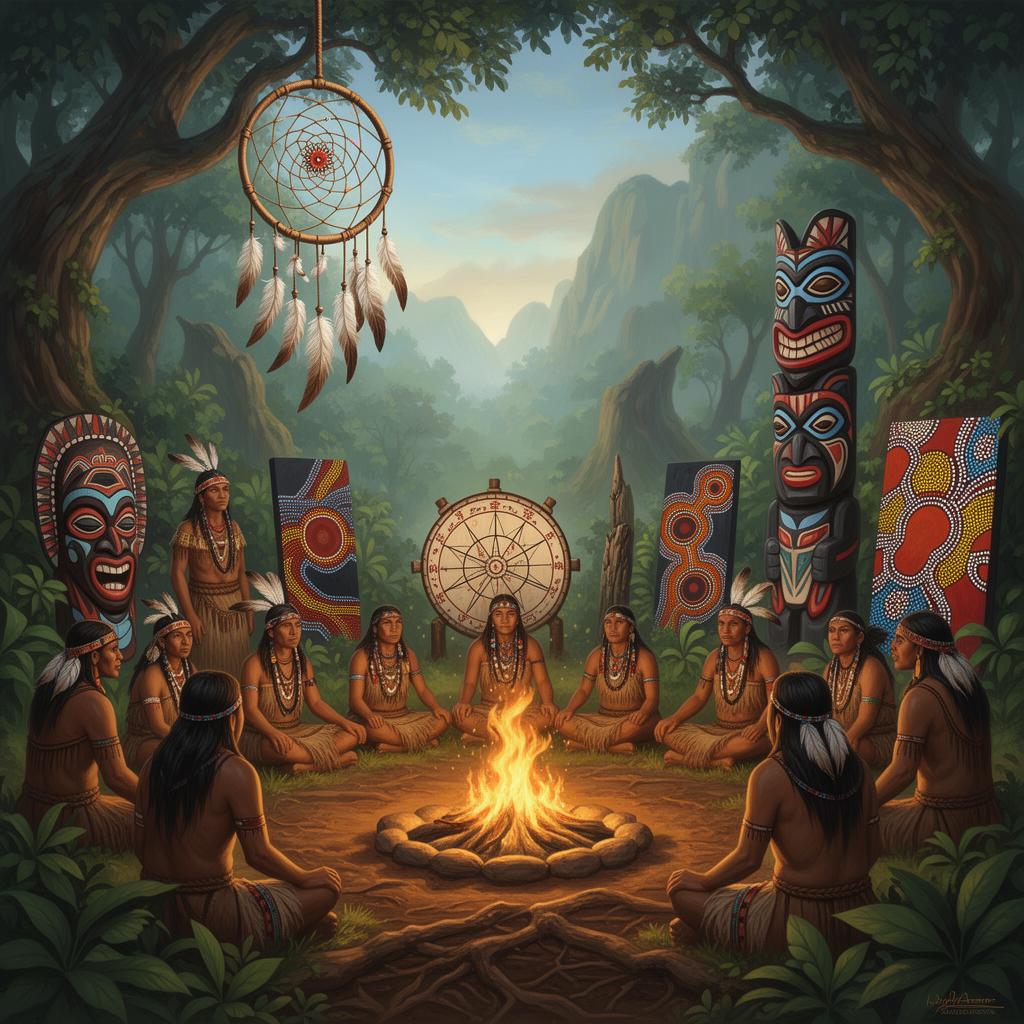
The Echoes of Earth: Indigenous and Native Traditions
Before the grand temples of ancient civilizations rose from the dust, before the scrolls were inked and the sacred texts penned, humanity already lived in profound relationship with the divine. This relationship wasn’t codified in dogma or encased in massive structures, but was woven into the very fabric of existence: the rustle of leaves, the roar of the ocean, the flight of an eagle, the rhythm of the seasons. These are the roots of Indigenous and Native traditions, a spiritual heritage as diverse as the landscapes they arise from, yet bound by a shared reverence for the Earth, community, and the timeless wisdom passed down through generations.
To speak of "Indigenous traditions" as a single entity is to attempt to capture starlight in a jar – impossible and reductive. These are not monolithic religions but rather a tapestry of countless distinct spiritual paths, each shaped by its unique environment, language, history, and people. From the vast plains of North America to the sprawling deserts of Australia, the lush forests of Africa to the countless islands of Polynesia, these traditions offer a kaleidoscope of spiritual understanding. Yet, despite their incredible diversity, certain profound themes emerge repeatedly, threads that connect humanity back to its most ancient understandings of the sacred.
Listening to the Land: A Sacred Connection to Nature
Perhaps the most defining characteristic of Indigenous spiritualities worldwide is their inseparable connection to the natural world. For many Indigenous peoples, the Earth is not merely a resource to be exploited or a backdrop for human drama; it is a living entity, a sacred mother, a primary source of spiritual sustenance and wisdom. Every mountain, river, tree, and animal is imbued with spirit, a relative in the grand cosmic family.
In the spiritual frameworks of numerous Native American nations, for instance, the land is seen as a relative. The Blackfoot people speak of the "Medicine Wheel," a symbol of the interconnectedness of all life and the four directions, each holding sacred meaning. The Lakota people, through ceremonies like the Inipi (sweat lodge), seek purification and connection to the Great Spirit (Wakan Tanka) within a sacred space designed to mirror the universe. Their prayers are often directed not just to a distant deity, but to the earth, the sky, the four winds, and all living things.
"We do not inherit the Earth from our Ancestors, we borrow it from our Children."
– Native American Proverb (attributed to various tribes)
This deep respect translates into a stewardship of the land that is profoundly spiritual. Practices often involve maintaining balance and harmony, understanding that human well-being is intrinsically linked to the health of the ecosystem. Hunting, gathering, and farming are often accompanied by rituals of gratitude, seeking permission from the spirits of the plants and animals, and ensuring that no more is taken than what is needed.
Across the Pacific, the Aboriginal peoples of Australia share a similarly profound bond with their ancestral lands, often referred to as "Country." For them, the landscape itself is a sacred geography, imprinted with the stories and journeys of ancestral beings during the "Dreaming" (also known as the Dreamtime). These stories are not myths in the Western sense, but rather a living reality, an ongoing spiritual presence that informs their identity, laws, and ceremonies. Particular rocks, waterholes, and trees are sacred sites, nexus points where the spiritual and physical worlds meet. Walking on Country is itself a spiritual act, a re-engagement with ancestors and creation.
In many African Traditional Religions (ATRs), the environment also plays a crucial role. Rivers, mountains, forests, and specific trees are often considered sacred, inhabited by deities, spirits, or ancestors. For the Yoruba people of West Africa, for example, specific Orishas (deities) are associated with different natural elements – Yemoja with the oceans, Oshun with rivers and sweet waters, Ogun with iron and forests. The living world is not separate from the spiritual world; it is an extension of it, and respectful interaction is paramount.
Polynesian cultures, living intimately with the vast ocean, developed spiritual traditions deeply intertwined with the sea, marine life, and the celestial navigation that allowed them to traverse immense distances. Deities often embody natural forces – Tangaroa, god of the sea; Rangi, the sky father; Papa, the earth mother. Their relationship with the land and sea is one of reciprocity, understanding that their survival depends on maintaining mana (spiritual power/authority) and observing proper protocols with the natural world.
Guardians of Memory: The Power of Oral Traditions
Unlike many world religions that rely heavily on written scriptures, Indigenous spiritualities are predominantly transmitted through oral traditions. This doesn't mean they are less sophisticated or profound; rather, it highlights a different approach to knowledge and wisdom. Storytelling, song, dance, ceremony, and practical demonstration are the vessels through which generations share their understanding of the world, their history, their laws, and their spiritual beliefs.
Every story carries not just information, but also the spirit and wisdom of those who came before. These oral narratives are often complex, layered, and multi-faceted, capable of being understood on different levels depending on the listener's age, maturity, and spiritual development. They often convey life lessons, moral codes, environmental knowledge, and cosmological insights, all wrapped in compelling narratives that engage the imagination and memory.
In Native American cultures, elders often hold the role of storytellers, passing down creation myths, heroic sagas, trickster tales, and historical accounts. These narratives often speak of the origins of the world, the relationships between humans and animals, and the spiritual principles that govern conduct. For instance, the myth of the White Buffalo Calf Woman bringing the sacred pipe to the Lakota people is a foundational story that teaches about peace, prayer, and right relationships.
Aboriginal Dreamtime stories, as mentioned earlier, are not just narratives but maps – both spiritual and literal. They describe the journeys of ancestral beings who shaped the land, leaving sacred sites and establishing the laws and customs that guide daily life. These stories are often performed through song and dance, making them living, breathing expressions of spiritual belief. The act of performing them is a way of re-enacting creation, reinforcing communal bonds, and ensuring the continuity of the ancestors' presence.
In African traditional societies, proverbs, praise poems, riddles, and epic narratives serve as the primary means of transmitting cultural values and spiritual knowledge. The griots of West Africa, for example, are revered oral historians, genealogists, and storytellers who maintain the collective memory of their communities, often accompanying their narratives with music. These stories frequently impart ethical lessons, explain natural phenomena, and connect the living to their ancestral lineage, which is a cornerstone of many ATRs.
Polynesian oral traditions, known as fono or tatau, are rich with genealogies, chants (oli or hula), and epic tales of voyaging heroes, creation, and gods. These narratives not only teach history and navigation but also embody the spiritual power (mana) of the ancestors. The intricate art of tattooing, for example, often tells a personal story and lineage, visually expressing an individual's connection to their ancestors and community.
Circle of Life: Communal Rituals and Ceremonies
Individual spirituality is often understood within the context of the collective in Indigenous traditions. Communal rituals and ceremonies are thus central to their spiritual expression, weaving individuals into the larger fabric of the community, the land, and the cosmos. These ceremonies mark life transitions, honor ancestors, heal the sick, ensure abundant harvests, or maintain balance with the spirit world.
In North America, ceremonies like the Sun Dance of the Plains nations are powerful expressions of communal sacrifice, prayer, and renewal, undertaken for the well-being of the entire community and all creation. Potlatches among the Pacific Northwest peoples are elaborate feasts and ceremonies that mark important social events, reinforce kinship ties, and redistribute wealth, affirming status and community cohesion. The Kachina rituals of the Pueblo peoples involve masked dancers embodying ancestral spirits who bring rain, fertility, and blessings to the community.
African Traditional Religions feature a wide array of communal rituals. Rites of passage – birth, initiation into adulthood, marriage, and death – are profoundly spiritual events, often involving elaborate ceremonies that guide individuals through these transitions and integrate them more fully into the community structure. Festivals celebrating harvest, appeasing spirits, or honoring specific deities involve music, dance, offerings, and communal feasting, reinforcing social bonds and spiritual connection.
In Aboriginal Australia, "Corroborees" are ceremonial gatherings that involve sacred songs, dances, and body painting, re-enacting Dreamtime stories. These events are not merely performances but vital acts of maintaining the spiritual landscape, reinforcing kinship, and transmitting knowledge. Initiation ceremonies, often held in secret and over extended periods, are crucial for passing on esoteric knowledge and marking the transition from childhood to responsible adulthood.
Polynesian cultures also place a high value on communal ceremonies. The Kava ceremony, for example, found across many Pacific islands, is a formal ritual involving the preparation and consumption of a mild sedative drink. It serves as a social glue, facilitating important discussions, welcoming guests, marking alliances, and connecting participants to spiritual realms. Hula in Hawaii is not just a dance but a sacred art form, a moving prayer that tells stories and honors deities and ancestors. Funeral rites are often elaborate, ensuring the smooth passage of the deceased's spirit and reinforcing the connection between the living and the ancestral world.
The Ancestors: A Living Presence
A distinctive feature of many Indigenous spiritualities is the profound and active role of ancestors. Unlike some traditions where ancestors are revered but somewhat distant, in many Indigenous cultures, ancestors are seen as a living presence, often residing in the spirit world but capable of influencing and guiding the living. They are not merely remembered; they are actively invoked, consulted, and honored.
For many African peoples, the ancestors are a vital link between the living and the divine. They are believed to be closer to God and can intercede on behalf of their descendants. Offerings, prayers, and rituals are regularly performed to maintain a good relationship with the ancestors, who are seen as guardians of morality, tradition, and community well-being. Disrespecting ancestors can lead to misfortune, while honoring them brings blessings.
Similarly, in numerous Native American traditions, ancestors are deeply respected and frequently called upon in ceremony. Their wisdom is sought through elders, dreams, and visions. Memorials and ceremonies often remind the living of their continuous connection to those who have passed, emphasizing the cyclical nature of life and death.
In Polynesian spirituality, the concept of ʻaumakua (ancestral spirits, often manifesting as animals) in Hawaii or similar guardian spirits elsewhere, highlights this enduring connection. These ancestors are guardians, protectors, and sources of guidance, whose wisdom is passed down through generations actively. Family genealogies (moʻokuʻauhau) are meticulously kept, connecting individuals to long lines of ancestors and grounding them in their spiritual heritage.
Shamans, Healers, and Spiritual Guides
Many Indigenous traditions have spiritual specialists who serve as intermediaries between the human and spirit worlds. These individuals, often called shamans, medicine people, healers, or diviners, undergo rigorous training and spiritual experiences to develop their abilities. Their roles vary but commonly include:
- Healing: Addressing physical, emotional, and spiritual ailments.
- Divination: Seeking guidance or foretelling future events.
- Dream Interpretation: Understanding messages from the spiritual realm.
- Ceremonial Leadership: Guiding rituals and ceremonies.
- Spirit Communication: Interacting with spirits, deities, and ancestors.
- Maintaining Balance: Helping the community and individuals restore harmony.
The path of a shaman or healer is often arduous, involving visions, sacrifices, and deep personal transformation. They are not merely practitioners of magic but profound spiritual leaders who embody the wisdom of their traditions and serve their communities with dedication.
Challenges and Resilience in a Modern World
Indigenous spiritualities have faced immense challenges throughout history – colonization, forced assimilation, suppression of language and culture, and the systematic disruption of traditional ways of life. Many sacred lands have been desecrated or stolen, traditional ceremonies outlawed, and spiritual leaders persecuted.
Yet, despite these profound adversities, Indigenous and Native traditions have demonstrated incredible resilience. There is a global resurgence of interest in and revitalization of these spiritual practices. Communities are reclaiming their languages, restoring sacred sites, and openly practicing ceremonies that were once driven underground. Younger generations are actively learning from elders, bridging the gap between ancient wisdom and contemporary challenges. This resilience is a testament to the enduring power and vital importance of these spiritual paths to human identity and well-being.
What Indigenous & Native Traditions Offer Humanity Today
In a world grappling with ecological crises, social fragmentation, and a search for deeper meaning, Indigenous and Native traditions offer invaluable lessons. They remind us that:
- We are part of nature, not separate from it. Their profound reverence for the Earth provides a powerful blueprint for sustainable living and ecological stewardship, teaching us to listen to the land and respect all forms of life as interconnected.
- Community is paramount. The emphasis on communal rituals and reciprocal relationships reminds us of the strength derived from collective identity and mutual support, countering the isolating tendencies of modern individualism.
- Wisdom is found in many forms. The vibrancy of oral traditions highlights the power of storytelling, song, and lived experience as vehicles for truth and meaning, encouraging us to value diverse forms of knowledge.
- Ancestors are not forgotten. The active role of ancestors in daily life reminds us of our continuity with the past, the wisdom of those who came before, and our responsibility to future generations.
- Spirit is everywhere. These traditions awaken us to the sacredness inherent in the everyday, the spiritual dimension of living in harmony with the cosmos, and the ever-present possibilities for connection and meaning.
The echoes of the Earth, carried through ancient songs, whispered in wind-swept stories, and danced into being through sacred ceremonies, offer a timeless wisdom that can help heal not only our planet but also our human spirit, guiding us toward a more respectful, balanced, and interconnected way of being in the world.