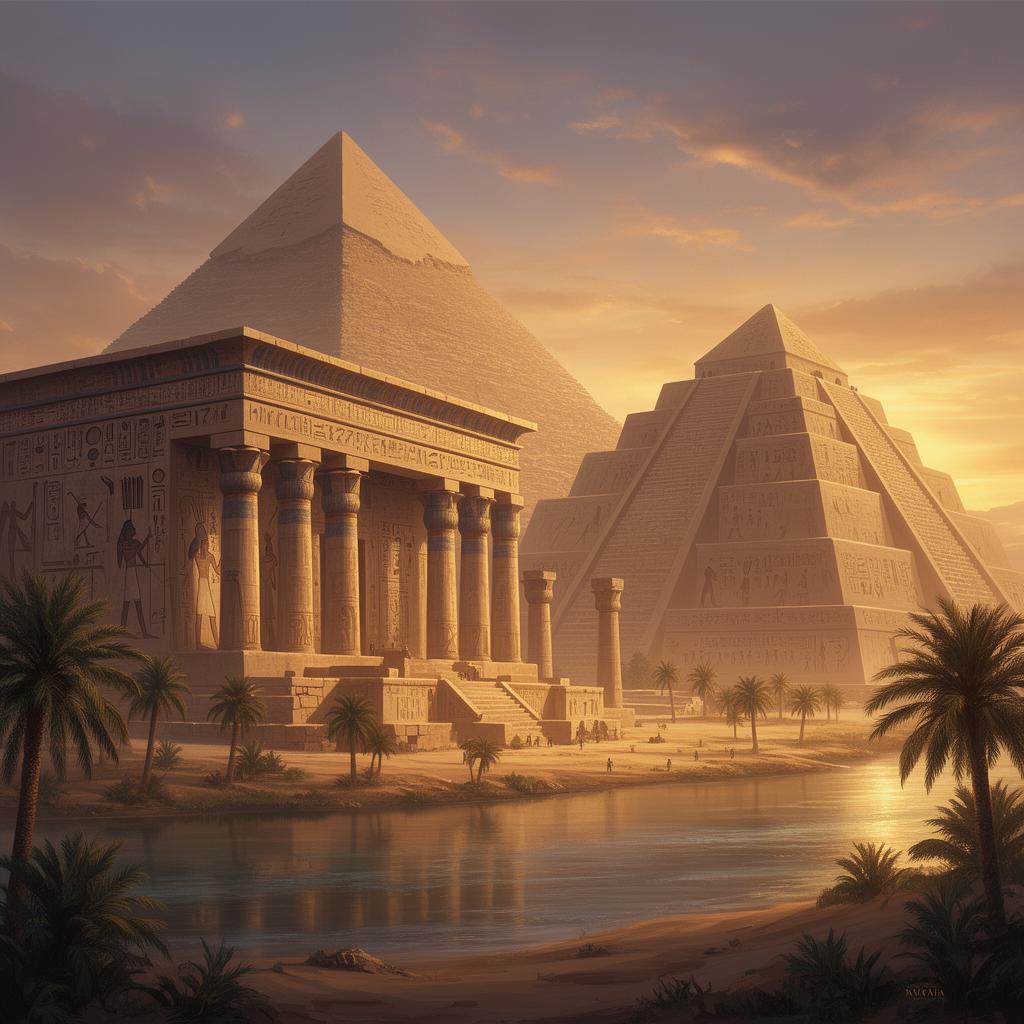
The Cradle of Civilizations: Faith in Mesopotamia and Egypt
Before the grand temples of Greece, before the prophets walked the lands of Judah, and long before the serene wisdom of the Buddha flowered, humanity was already reaching for the divine. In the fertile crescent between the Tigris and Euphrates rivers, and along the life-giving Nile, two colossal civilizations laid the foundations for much of what we recognize as religious thought today. These were the lands of ancient Mesopotamia and ancient Egypt, places where gods walked among humans, where creation was an ongoing symphony, and where the afterlife was an elaborate journey.
Imagine a world where the sun's scorching heat or a sudden, devastating flood could be a deity's whim. Imagine a world where the pharaoh was not just a ruler, but a living god, and where spirits whispered from every reed and rock. This is the spiritual landscape we are about to explore, a journey into the minds and hearts of people who, despite living millennia ago, grappled with universal questions of existence, purpose, and destiny.
Mesopotamia: A Land of Gods, Demons, and Cosmic Struggle
The name "Mesopotamia" itself means "the land between two rivers," a fitting description for a region that witnessed the rise and fall of various powerful civilizations: the Sumerians, Akkadians, Babylonians, and Assyrians, among others. Despite their distinct cultures and languages, they shared a surprisingly consistent religious worldview, a testament to the enduring power of their foundational myths and practices.
A Pantheon of Powerful, Often Impetuous Gods
The Mesopotamian pantheon was vast and complex, reflecting the myriad forces of nature and human experience. Unlike later monotheistic traditions, the gods here were numerous, each with their own domain and personality, often unpredictable and sometimes even capricious. They were anthropomorphic, meaning they possessed human-like qualities, emotions, and even flaws.
- Enlil (Sumerian) / Bel (Akkadian): Often considered the chief god, the lord of wind, air, storms, and the breath of life. He was a powerful but often harsh deity, capable of both creation and destruction.
- Enki (Sumerian) / Ea (Akkadian): The god of water, wisdom, magic, and crafts. He was generally seen as benevolent, a trickster who often intervened to help humanity.
- Nanna (Sumerian) / Sin (Akkadian): The moon god, often depicted as a wise and elderly figure.
- Utu (Sumerian) / Shamash (Akkadian): The sun god, associated with justice, law, and truth, who illuminated the world and saw all deeds.
- Inanna (Sumerian) / Ishtar (Akkadian): One of the most prominent goddesses, embodying love, war, fertility, and political power. She was a fierce and often contradictory figure.
- Marduk (Babylonian): The patron god of Babylon, who rose to supreme prominence during the Babylonian Empire, eventually assimilating many attributes of other gods.
- Ashur (Assyrian): The chief god of the Assyrian Empire, a war god who became deeply intertwined with the identity of the Assyrian state.
This polytheistic system wasn't static; as empires rose and fell, the prominence of certain deities shifted, and some gods even merged, reflecting the dynamic political landscape of the region.
Creation from Chaos: The Enuma Elish
The most famous Mesopotamian creation myth is the Babylonian Enuma Elish, or "When on High." This epic poem beautifully illustrates their cosmology: a world born from primeval chaos and conflict. It begins with a watery abyss, where two primordial beings, Apsu (the fresh water) and Tiamat (the salt water), mingle. Their union gives birth to the younger gods, whose boisterousness disturbs their parents.
Apsu plans to kill his offspring, but he is outsmarted and slain by Ea. Tiamat, enraged, creates an army of monsters to avenge her consort. The younger gods, terrified, choose Marduk, a powerful and clever god, to be their champion. Marduk defeats Tiamat in a cosmic battle, splitting her body in two. From one half, he creates the sky; from the other, the earth. He then fashions humanity from the blood of another slain god, Kingu, to serve the gods and relieve them of labor.
"When above the heaven had not been named,
Below the earth had not been called by name,
And no primordial Apsu, who begot them,
And no Tiamat, she who bore them all,
Their waters were mingling as a single body."
This narrative deeply influenced concepts of divine order, the origin of humanity, and the inherent struggle between order and chaos, themes that would echo in later traditions.
The Somber Afterlife: The Land of No Return
Mesopotamian views of the afterlife were generally bleak and somber. After death, all souls, regardless of their deeds in life, descended to the "Land of No Return," also known as Irkalla or Kurnugia, ruled by the goddess Ereshkigal. It was a dusty, dark realm beneath the earth, where the dead exist as shadowy forms, feeding on dust and clay. There was no concept of reward or punishment; it was a universal fate.
However, the manner of burial and the remembrance by the living were crucial. Proper burial rituals ensured a peaceful rest, and ongoing offerings from descendants were believed to sustain the dead. Without these, a restless spirit might return to torment the living. This emphasis on earthly remembrance highlights the Mesopotamian focus on the present life and the continuation of the family line, rather than a hopeful spiritual salvation.
Ziggurats: Stairways to Heaven
The most iconic religious structures of Mesopotamia were the ziggurats – massive, stepped pyramid structures with a temple at the very top. These weren't places for public worship but rather dwelling places for the gods on earth, thought to be cosmic mountains connecting heaven and earth. Priests and priestesses performed rituals and made offerings on behalf of the community within these sacred precincts.
The priesthood was highly influential, acting as intermediaries between humans and gods. They interpreted omens, performed divination, conducted elaborate rituals, and maintained the vast temple estates, which often functioned as major economic centers. Their knowledge of astronomy, mathematics, and writing was intimately connected to their religious duties.
Legacies of Mesopotamia
The Mesopotamian worldview, with its epic heroes like Gilgamesh, its flood narratives, its creation myths, and its intricate pantheon, reverberated through subsequent cultures. The narrative structure and themes found in texts like the Epic of Gilgamesh exhibit striking parallels with later biblical accounts, such as the story of the Great Flood. The understanding of deities, the role of priesthoods, the importance of temples, and complex legal codes often attributed to divine inspiration (like Hammurabi's Code) all laid groundwork for later religious and social structures.
Ancient Egypt: A Land of Immortality, Harmony, and Divine Pharaohs
Flowing through the arid desert, the Nile River was the lifeblood of ancient Egypt, and its predictable annual inundation brought fertility and bounty. This regularity deeply shaped the Egyptian worldview, instilling a sense of cosmic order, or Ma'at, and a powerful belief in cycles – life, death, and rebirth. Unlike the Mesopotamians, who often saw their gods as temperamental, the Egyptians generally perceived harmony with their deities and a far more optimistic view of the afterlife.
A Pantheon Reflecting Nature and Order
The Egyptian pantheon was equally vast and fascinating, often depicting deities with animal heads or composite forms, symbolizing their connection to the natural world. Many gods embodied specific natural phenomena, forces, or concepts, evolving over millennia with different cities and dynasties elevating certain deities.
- Ra (Re): The sun god, often depicted as a man with a falcon head wearing a sun disk. He was the creator god, who brought light and life to the world.
- Osiris: The god of the underworld, the dead, and resurrection. He was a benevolent ruler who taught humanity civilization.
- Isis: The goddess of magic, motherhood, and healing. She was Osiris's devoted wife and sister, a powerful protectress.
- Horus: Son of Osiris and Isis, often depicted as a falcon. He was the god of kingship, the sky, and protection, and the living pharaoh was considered his embodiment.
- Anubis: The jackal-headed god of embalming and guardian of the dead, who guided souls through the underworld.
- Thoth: Ibis-headed god of writing, knowledge, magic, and the moon.
- Hathor: Cow-headed goddess of love, music, joy, and fertility.
Unlike Mesopotamia, where gods were often distinct, Egyptian deities frequently merged (syncretism), taking on attributes of others. For example, Amun, a local god of Thebes, became Amun-Ra during the New Kingdom, combining with the sun god to become the supreme deity of the empire.
Creation from the Primordial Waters: Nun
Egyptian creation myths shared a common core: the emergence of order from primeval chaos, specifically from the waters of Nun. Various creation stories existed, often centered around specific cities or priesthoods.
- Heliopolitan Cosmogony: From the waters of Nun rose Atum, the self-created god. He masturbated or spat out Shu (air) and Tefnut (moisture). From them came Geb (earth) and Nut (sky), who, in turn, gave birth to Osiris, Isis, Set, and Nephthys. This creation myth emphasized sexual procreation and the orderly emergence of the cosmos from a single divine entity.
- Memphite Cosmogony: This version attributed creation to Ptah, the patron god of Memphis, who created the world through thought and speech – a powerful conceptual leap.
- Hermopolitan Cosmogony: This myth centered on the Ogdoad, eight primeval gods and goddesses who represented the chaotic elements of Nun, and whose interaction led to the emergence of the sun god and thus, creation.
Despite their variations, all these myths conveyed a fundamental belief in the ordered emergence of the world from chaos, a reflection of the cosmic order (Ma'at) that the Egyptians so deeply valued.
A Journey to the Afterlife: The Field of Reeds
The Egyptian afterlife was incredibly elaborate and optimistic compared to Mesopotamia. Death was not an end but a transition, a journey to the "Field of Reeds" (Aaru), a paradise mirroring life on earth but perfect and eternal. However, this journey was fraught with challenges and required careful preparation.
Central to this belief was the concept of the Ka (life force) and the Ba (personality/soul). After death, these components needed to reunite with the body for eternal life. This belief fueled the elaborate practices of mummification and the construction of immense tombs filled with provisions and spells to aid the deceased on their journey.
The deceased would undergo a series of trials, most famously the "Weighing of the Heart" ceremony, recounted in the Book of the Dead. In the presence of Osiris, Anubis would weigh the deceased's heart against the feather of Ma'at (truth and justice). If the heart was light and balanced, indicating a life lived in accordance with Ma'at, the deceased would pass into the Field of Reeds. If heavy with sin, it would be devoured by Ammit, the "Devourer of the Dead," leading to a second death, a far more terrifying prospect than the Mesopotamian underworld.
The pharaoh held a unique position. As the living Horus, a divine intermediary, his death was a cosmic event. His elaborate burial in pyramids and later in the Valley of the Kings was meant to ensure his successful rebirth as Osiris, guaranteeing the continued prosperity of Egypt.
Temples as Cosmic Centers and the Divine Pharaoh
Egyptian temples were stunning monumental structures, not truly public gathering places but rather cosmic centers and homes for the gods, where priests and the pharaoh performed daily rituals to maintain Ma'at and appease the deities. Within the deepest sanctuary resided the cult image of the god, accessed only by the highest priests and the pharaoh.
The pharaoh was the ultimate spiritual authority, a living god on earth, the son of Ra and the incarnation of Horus. He was the chief priest, responsible for maintaining Ma'at and ensuring the cosmic order through his rule and rituals. This divine kingship meant that the pharaoh’s well-being was intrinsically linked to the well-being of Egypt itself. The priesthood, while powerful, served at the pharaoh's discretion, carrying out the daily temple rites.
During the Amarna Period, Pharaoh Akhenaten attempted a radical religious revolution, promoting Aten, the sun disk, as the sole god, effectively moving towards monotheism. This was a dramatic departure from millennia of polytheism, but it was largely rejected by the people and reversed after his death, demonstrating the deep-rooted nature of traditional Egyptian beliefs.
Legacies of Ancient Egypt
Ancient Egypt's religious legacy is profound and enduring. Its emphasis on the soul's journey, judgment, and resurrection influenced later traditions, particularly early Christianity. Iconography such as the ankh (symbol of life), the winged sun disk, and various deities like Isis (who became a significant cult figure in the Roman world) spread far beyond Egypt's borders. The pyramids and elaborate burial customs continue to fascinate and inspire awe, reminding us of humanity's ancient quest for immortality and connection with the divine. The concept of a divine ruler, a king imbued with sacred power, also left a lasting imprint on concepts of kingship and political authority in other cultures.
Influences and Echoes in Later Traditions
The religious and spiritual frameworks established in Mesopotamia and Egypt were the fertile ground from which many later traditions would sprout. While direct lines of succession are complex and often debated, thematic and conceptual influences are evident:
- Flood Narratives: The Mesopotamian Gilgamesh epic's flood story bears striking resemblances to the biblical account of Noah's Ark, suggesting a shared cultural memory or epic tradition.
- Creation Myths: The idea of creation emerging from a primeval watery chaos, or through divine decree, is a common motif in many religious cosmologies.
- Divine Lawgivers: Kings like Hammurabi received their laws from the sun god Shamash, a precursor to the idea of Moses receiving the Torah from God on Mount Sinai.
- Afterlife Concepts: While different in specifics, the Egyptian emphasis on judgment, a perilous journey, and a blessed afterlife for the righteous arguably foreshadows similar ideas in Judaism, Christianity, and Islam.
- Mythological Motifs: Figures like the "Dying and Rising God" (Osiris) or the powerful mother goddess (Isis/Ishtar) are archetypes that reappear in various guises across subsequent mythologies and religions.
- Influence on Abrahamic Religions: Many scholars point to Mesopotamian and Egyptian religious concepts as influencing the emerging Hebrew traditions. The Exodus narrative, for example, is deeply embedded within an Egyptian context. The monotheistic leanings during Akhenaten's reign, though brief, might offer a conceptual glimpse of what was to come.
These ancient civilizations, in their vastness and complexity, were laboratories of faith. They grappled with the same fundamental questions that concern humanity today: Where do we come from? What is our purpose? What happens after we die? Their answers, etched in stone, woven into papyrus, and sung in ancient hymns, form the bedrock of our collective spiritual heritage.
What These Traditions Offer Humanity Today
The faiths of ancient Mesopotamia and Egypt, while distant in time, offer profound lessons and insights for contemporary humanity. They remind us of the profound human need to find meaning in the cosmos, to understand our place in the grand tapestry of existence, and to connect with forces greater than ourselves.
From Mesopotamia, we learn about the human struggle for meaning and order in an often-unpredictable world. Their myths speak to our fear of chaos, our desire for justice, and our longing for heroic figures who confront existential threats. They underscore the importance of communal identity and the enduring role of story in shaping cultural understanding. The somber afterlife views serve as a powerful reminder of the preciousness and brevity of earthly life, urging us to make our mark here and now through service and community.
From Egypt, we gain a unique perspective on harmony, order (Ma'at), and the cyclical nature of existence. Their meticulous preparation for the afterlife speaks to a deep hope for continuation and transformation, an affirmation that life has purpose even beyond death. The Egyptians teach us about the profound connection between nature, cosmos, and human well-being, fostering a sense of reverence for the environment. Their art and architecture, imbued with religious meaning, inspire awe and demonstrate humanity's capacity for monumental creativity driven by spiritual vision. The concept of the divine in everyday life, from the pharaoh to the humblest beetle, encourages a holistic view of the sacred.
Both traditions highlight the enduring human quest for wisdom, the power of ritual to bring communities together, and the deep-seated impulse to honor and interact with the spiritual realm. They reveal that spirituality is not a monolithic concept but a diverse and evolving response to the mysteries of life, a testament to the infinite ways in which humanity has reached out to touch the divine.