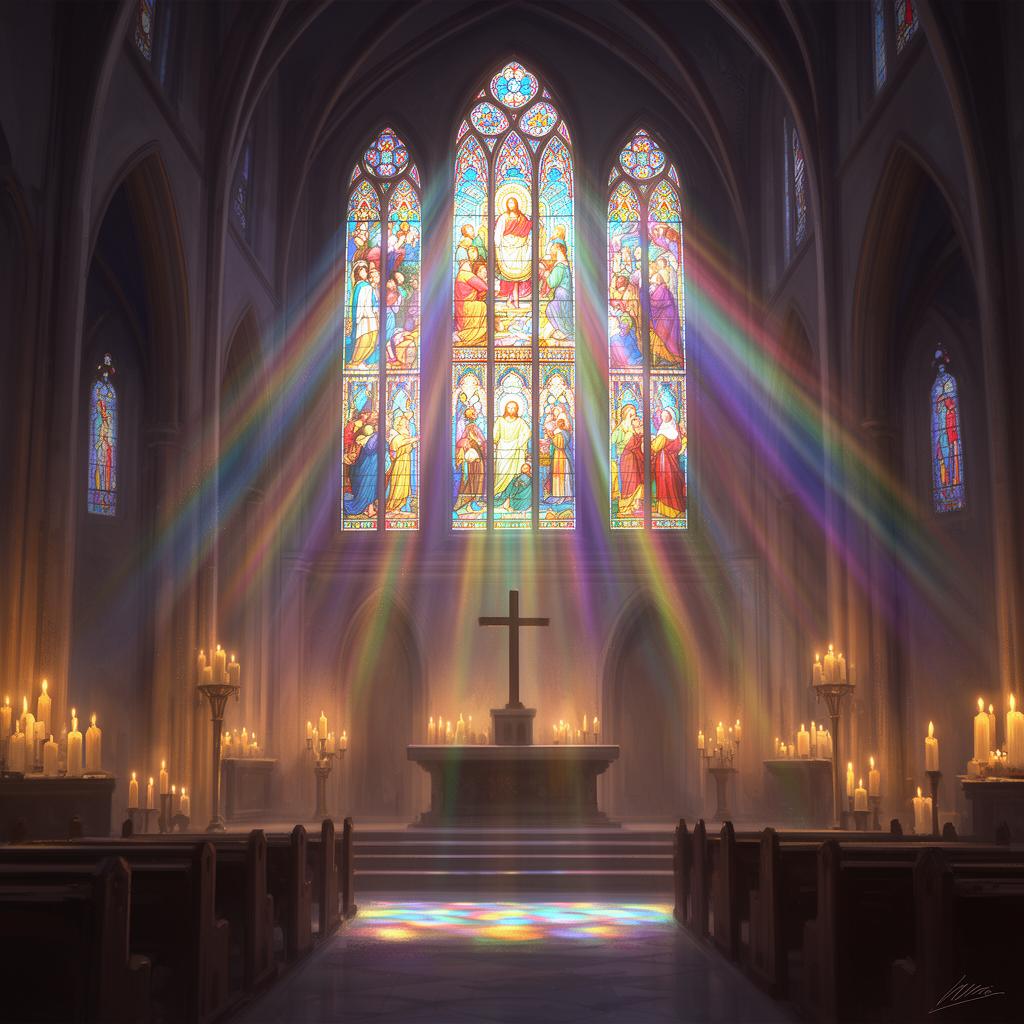
Christianity: Love & Redemption
From the arid landscapes of the Middle East, a story emerged that would fundamentally reshape human history and continues to resonate deeply in the hearts of billions. It's a story of sacrifice, radical love, and the profound hope of redemption – the narrative woven into the fabric of Christianity. More than just a religion, it became a cultural force, an artistic inspiration, and a moral compass for vast swathes of the world, offering a unique theological vision centered on the figure of Jesus of Nazareth.
The Humble Carpenter and the Radical Message: The Life of Jesus
Our journey begins in a small, provincial part of the Roman Empire, in the region of Galilee. Around the turn of the common era, in a town called Nazareth, a young man named Jesus grew up as a carpenter. His early life, largely unrecorded, gave no hint of the seismic impact he would have. Yet, at around the age of thirty, he began an itinerant ministry that lasted perhaps only three years, but those years would echo through millennia.
Jesus' message was both simple and revolutionary. He spoke of the "Kingdom of God" – not an earthly empire, but a spiritual one, characterized by justice, mercy, and profound love. He taught through parables, engaging stories that revealed deep spiritual truths accessible to both the learned and the unlettered. His sermons, most famously the Sermon on the Mount, challenged conventional wisdom, advocating for:
- Love for enemies: "But I say to you, love your enemies, bless those who curse you, do good to those who hate you, and pray for those who spitefully use you and persecute you." (Matthew 5:44)
- Humility: "Blessed are the poor in spirit, for theirs is the kingdom of heaven." (Matthew 5:3)
- Forgiveness: Not just seven times, but seventy-seven times (Matthew 18:22), emphasizing boundless grace.
- Service to the marginalized: Identifying himself with "the least of these" – the hungry, the sick, the imprisoned.
Jesus demonstrated his teachings through his actions. He healed the sick, cast out demons, and comforted the sorrowful. He welcomed outcasts, dined with tax collectors and prostitutes, and challenged the rigid religious establishment of his day, who he accused of hypocrisy and prioritizing ritual over compassion. This radical inclusivity, coupled with his claims of divine authority and his growing popularity, inevitably brought him into conflict with both Jewish religious leaders and the Roman authorities.
His ministry culminated in Jerusalem during the Passover festival. Arrested on charges of sedition and blasphemy, he was tried and condemned to death by crucifixion, a brutal form of execution reserved for the worst criminals. His followers were devastated, their hopes for a new age seemingly dashed. However, the story did not end there. Three days later, his tomb was found empty, and his disciples reported encountering him alive, resurrected from the dead. This resurrection became the cornerstone of Christian faith – the ultimate victory over sin and death, offering hope for eternal life.
From Small Gatherings to a Spreading Movement: The Apostolic Age
The period immediately following Jesus' ascension – known as the Apostolic Age – was a transformative one. Empowered by what they believed to be the Holy Spirit on the day of Pentecost (Acts 2), Jesus' disciples, now apostles, went forth with incredible zeal. Peter, a fisherman, became a bold preacher, converting thousands. Paul, initially a persecutor of Christians named Saul, experienced a dramatic conversion on the road to Damascus and became arguably the most influential figure in early Christianity, transforming it from a localized Jewish sect into a universal faith.
Paul's tireless missionary journeys crisscrossed the Roman Empire, from Jerusalem to Antioch, Ephesus, Corinth, and ultimately Rome. He wrote numerous letters (epistles) to fledgling Christian communities, addressing theological questions, resolving disputes, and offering guidance on living a Christian life. These letters would later become integral parts of the New Testament.
The early Christian communities, often meeting in homes, faced immense challenges, including persecution from both Jewish and Roman authorities. Yet, their unwavering faith, their communal bonds, their practice of shared meals (the Eucharist), and their care for the poor and sick, drew more and more adherents. The message of Jesus, initially delivered in Aramaic, was translated into Greek, the common language of the Roman Empire, allowing it to spread rapidly.
The Sacred Texts: The New Testament
As the early Christian movement grew, the need for authoritative writings became clear. The foundational texts for Christians are the Old Testament (shared with Judaism, though Protestants and Catholics have slightly different canons) and the New Testament, which is uniquely Christian.
The New Testament consists of 27 books, meticulously compiled over several centuries. It primarily includes:
- The Gospels (Matthew, Mark, Luke, John): Four distinct accounts of Jesus' life, ministry, death, and resurrection. While varying in style and emphasis, they collectively paint a portrait of the Christ.
- The Acts of the Apostles: A historical narrative chronicling the early church, particularly the ministries of Peter and Paul.
- The Epistles (Letters): Primarily written by Paul, but also by Peter, James, John, and Jude, offering theological instruction, ethical guidance, and encouragement to early Christian communities.
- The Book of Revelation: An apocalyptic vision by John, offering symbolic glimpses into the end times and God's ultimate triumph.
These texts were not instantly canonized. It was a gradual process, driven by the needs of the church to define orthodox belief and protect against heresies. By the end of the 4th century CE, a broad consensus had emerged on the 27 books that form the New Testament as we know it today, believed to be divinely inspired and authoritative for Christian faith and practice.
Defining Belief: Early Church Councils and Creeds
As Christianity spread, it encountered diverse philosophical traditions and spiritual questions. This led to various interpretations of Jesus' nature, the Holy Trinity, and the relationship between God and humanity. To address these theological debates and establish uniform doctrine, the early church convened a series of ecumenical councils.
The most significant of these were:
- Council of Nicaea (325 CE): Convened by Emperor Constantine, this council addressed Arianism, which denied the full divinity of Jesus. The Nicene Creed, formulated here, declared Jesus to be "God from God, Light from Light, true God from true God, begotten, not made, consubstantial with the Father."
- Council of Constantinople (381 CE): Reaffirmed the Nicene Creed and clarified the divinity of the Holy Spirit, leading to the full understanding of the Trinity as God the Father, God the Son (Jesus Christ), and God the Holy Spirit, three persons in one divine being.
- Council of Chalcedon (451 CE): Addressed debates about the two natures of Christ (divine and human), affirming that Jesus is one person with two distinct, unconfused, unchanged, undivided, and inseparable natures.
These councils and the creeds they produced established the core theological tenets that would bind together diverse Christian communities for centuries, providing a shared understanding of God and Christ.
A Deepening Rift: The Great Schism
Despite these unifying efforts, theological and cultural differences began to emerge and deepen between the Latin-speaking West (Rome) and the Greek-speaking East (Constantinople). These differences, exacerbated by political rivalries and linguistic barriers, eventually led to the Great Schism of 1054 CE.
Key points of contention included:
- Papal Authority: The Western Church believed the Pope, as the successor of Peter, held universal authority over the entire Christian Church. The Eastern Church respected the Pope as "first among equals" but rejected his claims to supreme authority over other patriarchs.
- The Filioque Clause: The Western Church added the Latin phrase "Filioque" ("and the Son") to the Nicene Creed, stating that the Holy Spirit proceeds from the Father *and the Son*. The Eastern Church viewed this as an unauthorized alteration of a universally accepted creed and a theological error, believing the Holy Spirit proceeds from the Father alone.
- Liturgical Practices: Differences in fasting customs, the use of leavened vs. unleavened bread in the Eucharist, and clerical celibacy (enforced in the West, optional for priests in the East).
While attempts at reconciliation occurred, the mutual excommunications between Pope Leo IX and Patriarch Michael I in 1054 formalized the split, creating the Roman Catholic Church in the West and the Eastern Orthodox Church in the East. This division remains fundamental to Christian history.
A Call for Reform: The Reformation
Centuries later, the Western Church itself faced immense internal pressure for reform. By the 16th century, many felt that the Roman Catholic Church had grown corrupt, distanced from its evangelical roots, and focused on temporal power and wealth rather than spiritual guidance.
The spark that ignited the Protestant Reformation was Martin Luther, an Augustinian monk in Germany. In 1517, he famously posted his "Ninety-five Theses" on the door of the church in Wittenberg, challenging the practice of selling indulgences – papal pardons for sins. Luther’s core theological insights, which became the bedrock of Protestantism, were:
- Sola Scriptura (Scripture Alone): The Bible is the sole infallible source of religious authority, challenging the authority of tradition and papal decrees.
- Sola Fide (Faith Alone): Salvation is received by grace through faith in Jesus Christ, not by good works or rituals.
- Sola Gratia (Grace Alone): Salvation is a free gift from God, unearned by human effort.
- Solus Christus (Christ Alone): Jesus Christ is the sole mediator between God and humanity.
- Soli Deo Gloria (Glory to God Alone): All glory belongs to God alone.
Luther's challenge rapidly gained traction, fueled by the recently invented printing press, which allowed his writings and German translation of the Bible to spread widely. Other reformers like John Calvin in Switzerland developed their own theological systems, emphasizing God's sovereignty and predestination. In England, King Henry VIII's desire for an annulment led to the formation of the Church of England (Anglicanism).
The Reformation shattered the religious unity of Western Europe, leading to centuries of religious wars but also fostering intellectual inquiry, literacy, and new forms of worship and church governance. It gave rise to numerous Protestant denominations, including Lutheranism, Calvinism (Presbyterianism, Reformed Churches), Baptism, Methodism, and many others, each with its distinctive interpretations and practices.
A Global Faith: Christianity's Spread and Diversity
From its humble origins, Christianity, through missionary efforts, colonialism, and global movements, has spread to every continent. Today, with over 2.4 billion adherents, it is the world's largest religion, characterized by astounding diversity:
- Roman Catholicism: The largest single Christian denomination, with over 1.3 billion members, characterized by a hierarchical structure with the Pope as its head, seven sacraments, and a rich tradition of liturgy and theology.
- Protestantism: A vast umbrella term encompassing hundreds of denominations, emphasizing the Bible, personal faith, and often a simpler liturgy. Major branches include Baptists, Methodists, Lutherans, Presbyterians, Pentecostals, Evangelicals, and many non-denominational churches.
- Eastern Orthodoxy: The second-largest Christian communion, with about 300 million members, present primarily in Eastern Europe, the Middle East, and Russia, known for its rich liturgical traditions, icons, and maintaining the early church's theological distinctives.
- Oriental Orthodoxy: Churches like the Coptic, Ethiopian, Eritrean, Syriac, Armenian, and Malankara Orthodox churches, which separated from the main body of Christianity after the Council of Chalcedon due to theological differences regarding the nature of Christ.
- Other Christian Traditions: Including ancient churches like the Assyrian Church of the East, and newer movements like The Church of Jesus Christ of Latter-day Saints (Mormonism) and Jehovah's Witnesses, which are sometimes considered distinct enough to be separate Abrahamic traditions but share roots in the Christian narrative.
Despite their differences, most Christian denominations share core beliefs:
- The Trinity: Belief in one God existing as three co-equal, co-eternal persons: Father, Son (Jesus Christ), and Holy Spirit.
- Divinity of Jesus Christ: Belief that Jesus is fully God and fully human.
- Atonement: Belief that Jesus' death on the cross atoned for humanity's sins, reconciling humanity with God.
- Resurrection: Belief in Jesus' bodily resurrection from the dead, offering hope for eternal life for believers.
- The Bible: Accepted as the inspired Word of God.
- Salvation: Achieved through God's grace and faith in Christ.
- Coming of the Kingdom of God: The belief in God's ultimate plan for justice, peace, and renewed creation.
Christianity continues to be a dynamic and evolving faith, grappling with modern challenges, engaging in social justice, offering spiritual solace, and fostering communities of worship and service across the globe.
Christianity Today: A Living Legacy
Today, Christianity continues to be a profound force for good in the world, influencing countless individuals and societies. Its message of radical love, forgiveness, and redemption speaks to the deepest human longings. In a world often fractured by conflict and despair, Christianity offers a narrative of hope – a belief in a God who entered human suffering, demonstrated boundless compassion, and ultimately triumphed over death.
The emphasis on personal transformation, ethical living, and service to others remains central. Christian organizations are at the forefront of humanitarian aid, healthcare, education, and advocacy for the marginalized. While the historical journey of Christianity has its complex chapters, marked by both profound goodness and human failings, its enduring core values, derived from the teachings of Jesus, continue to inspire billions to seek a life of purpose, compassion, and faith.
In its ongoing story, Christianity reminds us that even in a fallen world, love has the final word, and redemption is always possible.