Buddhism — The Middle Path
In the vibrant tapestry of human spirituality, there are threads that shimmer with the promise of peace, threads woven with profound wisdom, and threads that guide us through the labyrinth of suffering towards liberation. Among these, few glow with such enduring radiance as Buddhism, a path inaugurated by a prince who left behind palaces and pleasures to seek an end to sorrow. It is a tradition that, for over two millennia, has offered a unique perspective on the human condition, emphasizing self-discovery, compassion, and the transformative power of understanding.
The Prince Who Sought Freedom: Siddhartha Gautama
Our journey into Buddhism begins not with a deity, but with a man, Siddhartha Gautama, born into royalty in the 6th or 5th century BCE in Lumbini, in what is now Nepal. His birth was steeped in legend, prophesies foretelling either a great king or a great spiritual leader. His father, wishing for the former, shielded young Siddhartha from all forms of suffering. He grew up in lavish palaces, surrounded by beauty, pleasure, and every conceivable comfort. He had a loving wife, a son, and a life devoid of hardship. Yet, beneath the gilded surface, a profound unease stirred within him.
The story of Siddhartha’s "Four Sights" is pivotal to his awakening. Despite his father’s efforts, one day, venturing outside the palace walls, he encountered realities he had never known. First, he saw an old man, frail and stooped, experiencing the inevitable decay of age. Then, he saw a sick person, wracked with pain and disease. Next, he witnessed a funeral procession, observing the sorrow of death. These encounters shattered his sheltered illusion, revealing the pervasive nature of suffering inherent in existence.
Finally, he saw an ascetic, a serene renunciant, radiating a profound tranquility despite his simple, unadorned life. This figure offered Siddhartha a glimpse of a different path, a way to transcend the suffering he had just witnessed. The contrast was stark: the fleeting pleasures of his princely life versus the enduring peace of the renunciant. Overwhelmed by the impermanence of all things and the inevitability of suffering, Siddhartha, at the age of 29, made a monumental decision. He left his family, his wealth, and his future as a king to embark on a spiritual quest.
This act of "Great Renunciation" led him through years of intense asceticism. He sought enlightenment through extreme self-denial, fasting, meditating in harsh conditions, and pushing his body to the brink of survival. He studied with renowned spiritual teachers, mastering various yogic and meditative practices. Yet, even in the deepest trances, the ultimate liberation he sought eluded him. He realized that extreme indulgence had not brought him peace, nor had extreme asceticism. Both were extremes that led to further suffering.
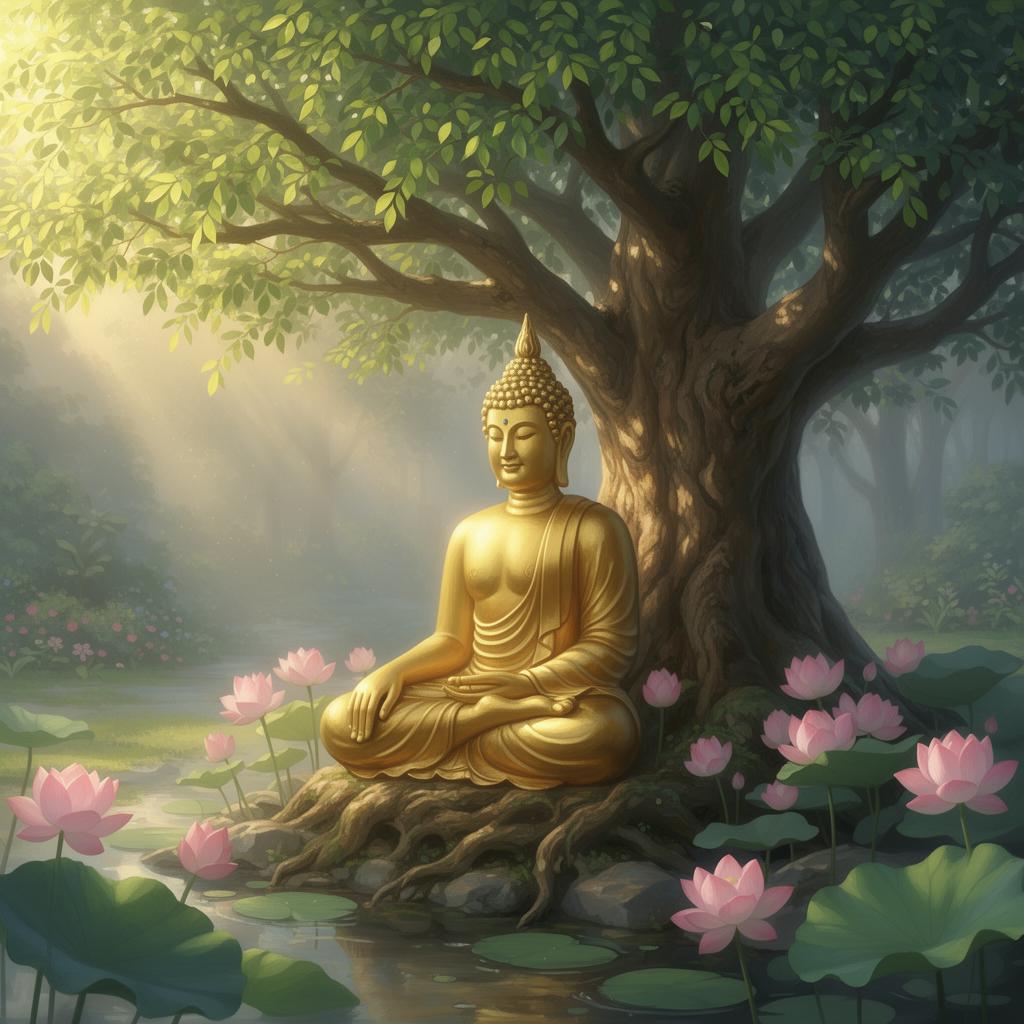
It was then that he embraced what he would later call "The Middle Path." He accepted a bowl of rice milk from a village girl, regaining strength, and sat beneath a Bodhi tree in Bodh Gaya, resolutely vowing not to rise until he had attained complete understanding. Through prolonged meditation, battling internal demons and distractions, he broke through the veil of ignorance. He saw the nature of existence, the causes of suffering, and the path to its cessation. He became the Buddha, "the Awakened One," or "the Enlightened One." His enlightenment marked a pivotal moment in human history, offering a new blueprint for understanding the mind and the world.
The Core Teachings: The Four Noble Truths
After his enlightenment, the Buddha traveled to Sarnath and delivered his first sermon, outlining the fundamental principles of his discovery. These teachings are encapsulated in the "Four Noble Truths," which form the bedrock of all Buddhist traditions. They are not doctrines to be blindly believed, but rather insights to be understood through personal experience and reflection, akin to a medical diagnosis and prescription:
-
Dukkha: The Truth of Suffering.
Life, at its core, involves suffering. This isn't to say life is devoid of joy or pleasure, but rather that all forms of existence are characterized by a pervasive unsatisfactoriness (dukkha). This includes obvious forms of suffering like pain, old age, sickness, and death, but also the more subtle forms: the suffering of impermanence (even joy is fleeting), the suffering of dissatisfaction (never being truly content), and the suffering of conditioned existence (being subject to causes and conditions beyond our control).
"Now this, monks, is the noble truth of suffering: birth is suffering, aging is suffering, illness is suffering, death is suffering; sorrow, lamentation, pain, grief, and despair are suffering; association with the unpleasant is suffering; separation from the pleasant is suffering; not getting what one wants is suffering — in short, the five clinging-aggregates are suffering." - The Buddha
-
Samudaya: The Truth of the Origin of Suffering.
This suffering is not random or without cause. Its primary origin is craving or attachment (trishna). This craving manifests in various forms: craving for sensual pleasures, craving for becoming (to exist, to be important, to acquire), and craving for non-becoming (to cease to exist, to avoid pain, to destroy). It is this insatiable desire, born of ignorance about the true nature of reality, that binds us to the cycle of suffering and rebirth (samsara).
-
Nirodha: The Truth of the Cessation of Suffering.
Because suffering has a cause, it can be ended. This cessation is called Nirvana, a state of profound peace, freedom, and liberation. Nirvana means "blowing out" – extinguishing the fires of craving, aversion, and ignorance. It is not an annihilation of self, but rather the liberation from the illusion of a permanent, separate self and the suffering that arises from it.
-
Magga: The Truth of the Path to the Cessation of Suffering.
There is a path that leads to the cessation of suffering. This is the "Middle Path," a practical guide to ethical conduct, mental discipline, and wisdom, which avoids the extremes of indulgence and asceticism. This path is known as the Eightfold Path.
The Practice: The Eightfold Path
The Eightfold Path (or Noble Eightfold Path) is not a linear progression, but rather a set of interconnected practices that are cultivated simultaneously, reinforcing one another. It is divided into three sections: Wisdom (Panna), Ethical Conduct (Sila), and Mental Discipline (Samadhi).
-
Wisdom (Panna):
- Right Understanding (Samma Ditthi): Comprehending the Four Noble Truths and the nature of reality as impermanent, unsatisfactory, and non-self.
- Right Thought/Intention (Samma Sankappa): Cultivating thoughts of renunciation, goodwill (mettā), and harmlessness (karuṇā), moving away from greed, hatred, and cruelty.
-
Ethical Conduct (Sila):
- Right Speech (Samma Vaca): Abstaining from lying, divisive speech, harsh speech, and idle chatter; speaking truthfully, kindly, and beneficially.
- Right Action (Samma Kammanta): Abstaining from killing, stealing, and sexual misconduct; engaging in ethical, harmonious actions.
- Right Livelihood (Samma Ajiva): Earning a living in a way that does not harm others or oneself, avoiding trades that involve weapons, slavery, animal slaughter, poisons, or intoxicants.
-
Mental Discipline (Samadhi):
- Right Effort (Samma Vayama): Striving to prevent unwholesome states from arising, to abandon existing unwholesome states, to arouse wholesome states, and to maintain existing wholesome states.
- Right Mindfulness (Samma Sati): Maintaining clear awareness of the present moment – thoughts, feelings, bodily sensations, and phenomena – without judgment or attachment.
- Right Concentration (Samma Samadhi): Developing focused attention through meditation, leading to states of deep calm and one-pointedness of mind (jhana), essential for insight.
The Eightfold Path is a practical guide for daily living, a journey of self-transformation that aims to purify the mind, cultivate compassion, and ultimately lead to the freedom of Nirvana. It emphasizes personal effort, self-reliance, and the development of inner wisdom rather than reliance on external authority or ritual.
The Sacred Texts: The Tripitaka
The foundational scriptures of Buddhism are primarily preserved in the Pali Canon, known as the Tripitaka (meaning "Three Baskets") because of the three sections into which it is divided. While different Buddhist schools have their own additional sutras and commentaries, the Tripitaka forms the common textual core.
- Vinaya Pitaka (Basket of Discipline): This section contains the rules and regulations for the monastic community (sangha) of monks (bhikkhus) and nuns (bhikkhunis). It details the procedures for ordinations, ceremonies, and the conduct expected of monastics. It provides the framework for the disciplined community life that supports spiritual practice.
- Sutta Pitaka (Basket of Discourses): This is the largest section, comprising the Buddha's discourses (suttas or sutras) and dialogues, along with those of his close disciples. It contains the central teachings like the Four Noble Truths, the Eightfold Path, and numerous parables, stories, and expositions on doctrine. It is the primary source for understanding the Buddha's philosophy and ethical framework.
- Abhidhamma Pitaka (Basket of Higher Teachings): This "higher doctrine" or "special doctrine" is a systematic analysis and categorization of the Buddha's teachings. It delves into the precise psychological and philosophical aspects, dissecting phenomena into ultimate constituents (dharmas) and exploring the workings of the mind in great detail. It is considered a more philosophical and scholastic exposition of the Dharma.
The Tripitaka, memorized and orally transmitted for centuries before being written down, represents the closest we have to the original teachings of the Buddha. Its preservation and study have been central to the continuity of the Buddhist tradition.
The Spreading Branches: Buddhism Across Asia
Buddhism, unlike many religions, did not primarily spread through conquest or coercion, but through the gentle persuasion of its teachings, the exemplary lives of its monastics, and the patronage of rulers. From its origins in ancient India, it branched out gracefully across the vast continent of Asia, adapting and flourishing in diverse cultural contexts.
Early Expansion
After the Buddha's passing, his teachings were preserved and propagated by his disciples. A significant turning point came in the 3rd century BCE with Emperor Ashoka the Great of the Mauryan Empire. After a brutal war, Ashoka converted to Buddhism and became its most ardent patron. He famously renounced violence, adopted policies based on peace and compassion, and dispatched Buddhist missionaries (Dharma-mahāmātras) across India and beyond, including to Sri Lanka, Southeast Asia, and the Middle East. His reign transformed Buddhism from a regional Indian movement into a major world religion.
To the East: China, Korea, and Japan
Buddhism arrived in China via the Silk Road in the 1st century CE. It initially faced resistance but gradually gained traction, profoundly influencing Chinese philosophy, art, and literature. The translation of Buddhist scriptures into Chinese spurred immense intellectual activity. From China, Buddhism spread to Korea in the 4th century and then to Japan in the 6th century. In each of these countries, it blended with existing indigenous traditions, such as Daoism and Confucianism in China, and Shinto in Japan, giving rise to unique forms of Buddhist practice and thought like Chan (later Zen) and Pure Land Buddhism.
To the South: Southeast Asia
From India and Sri Lanka, Buddhism also traveled south to Southeast Asia. Today, countries like Thailand, Myanmar, Laos, and Cambodia are predominantly Theravada Buddhist. This tradition emphasizes a literal and conservative interpretation of the Pali Canon and the monastic ideal. Grand stupas and ancient temples like Angkor Wat stand as magnificent testaments to the historical and cultural impact of Buddhism in this region.
To the North: Tibet and the Himalayas
Buddhism arrived in Tibet in the 7th century CE, evolving into a highly distinctive form known as Vajrayana or Tibetan Buddhism. This tradition incorporates elements of ancient Tibetan Bon religion, tantric practices, intricate rituals, and the guidance of reincarnated lamas, with the Dalai Lama being its most renowned spiritual leader. Vajrayana emphasizes rapid enlightenment through specialized practices and the guidance of a guru.
Diverse Paths, Common Goal: Theravada, Mahayana, and Vajrayana
Over the centuries, as Buddhism spread and evolved, different schools or "vehicles" emerged, each emphasizing certain aspects of the Dharma and adapting to local cultures. While they share the fundamental teachings of the Buddha (the Four Noble Truths, the Eightfold Path, Dependent Origination), their approaches, scriptural canons, and practices can differ significantly.
Theravada ("The Way of the Elders")
Predominantly practiced in Sri Lanka, Thailand, Myanmar, Laos, and Cambodia, Theravada is considered the oldest and most conservative branch of Buddhism. It emphasizes a strict adherence to the original teachings found in the Pali Canon and the monastic ideal. The ultimate goal in Theravada is to become an Arahant (Arhat), one who has achieved personal enlightenment, individual liberation from suffering, and transcended the cycle of rebirth by following the Buddha's path. While not rejecting the role of compassion, Theravada places a strong emphasis on individual effort and insight meditation (vipassanā) as the means to liberation. Monastic life is central, and lay practitioners support the monastics in exchange for teachings and blessings.
Mahayana ("The Great Vehicle")
Widespread in China, Japan, Korea, Vietnam, and parts of Tibet, Mahayana Buddhism developed several centuries after the Buddha's passing. It is called the "Great Vehicle" because it offers a path to enlightenment for all beings, not just monastics. A key ideal in Mahayana is the Bodhisattva: an enlightened being who, out of boundless compassion (karuṇā), postpones their own Nirvana to remain in the world and help all other sentient beings achieve awakening. Mahayana vastly expanded the Buddhist canon, introducing new sutras like the Prajnaparamita (Perfection of Wisdom) Sutras and the Lotus Sutra. It encompasses diverse schools like Zen (Chan), Pure Land, and Tiantai, each with unique philosophical tenets and practices, but all united by the Bodhisattva ideal.
Vajrayana ("The Diamond Vehicle" or "Thunderbolt Vehicle")
Primarily found in Tibet, Nepal, Bhutan, Mongolia, and parts of India and China, Vajrayana is often considered a subset or extension of Mahayana, sometimes referred to as Tantric Buddhism. It takes the Bodhisattva ideal of compassion to its extreme, aiming for enlightenment in a single lifetime to better serve all beings. Vajrayana incorporates a rich array of esoteric practices, rituals, visualizations, mantras, mudras (hand gestures), and mandalas. It emphasizes the guidance of a guru (lama) and the use of powerful techniques (tantras) to quickly transform negative emotions and access innate wisdom. Symbolically, the "diamond" or "thunderbolt" represents the indestructible, clear, and powerful nature of wisdom that can cut through illusion, leading to rapid spiritual progress.
Despite their differences, all these traditions share the fundamental aim of ending suffering and recognize the Buddha as the supreme guide. They each offer a unique and valid path to cultivating wisdom, compassion, and ultimate liberation.
What Buddhism Offers Humanity Today
In a world often characterized by rapid change, anxiety, and conflict, the ancient wisdom of Buddhism offers profound and timely insights. At its heart, Buddhism is a psychology of liberation, a science of the mind that invites introspection and personal experience rather than blind faith. It offers a framework for understanding suffering not as a punishment, but as a solvable problem, arising from identifiable causes within ourselves.
The emphasis on mindfulness and meditation provides powerful tools for navigating stress and cultivating inner peace, practices increasingly embraced even in secular contexts for their therapeutic benefits. The cultivation of compassion (karuṇā) and loving-kindness (mettā) directly addresses the divisiveness and lack of empathy prevalent in many societies, encouraging a fundamental interconnectedness with all beings. The teaching of impermanence (anicca) helps us adapt to change, release attachments, and find acceptance in a world that constantly shifts. The understanding of non-self (anattā) subtly dismantles the rigid ego, fostering humility and reducing the sources of so much conflict and self-centeredness.
In its timeless call to examine our own minds, to live ethically, and to extend kindness to all, Buddhism provides a beacon for personal and collective well-being. It reminds us that true freedom is not found in external circumstances, but in the liberation of the mind from the shackles of craving, aversion, and ignorance – a path as relevant and urgent today as it was millennia ago under the Bodhi tree.