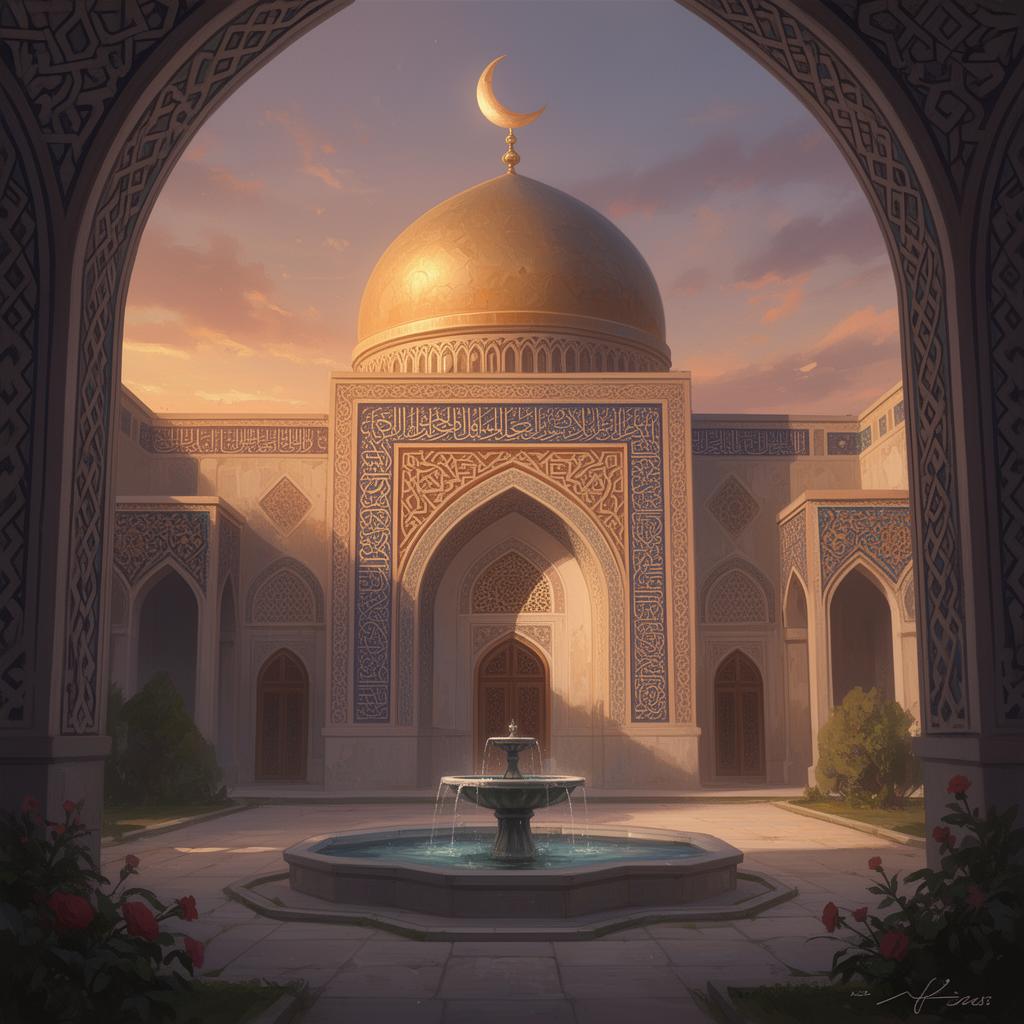
Islam — Submission to the One God
Imagine a vibrant tapestry woven with threads of deep devotion, intellectual fervor, and an unwavering commitment to justice. This is Islam, a global faith that has shaped civilizations, inspired breathtaking art, and offered guidance to billions for over fourteen centuries. The word "Islam" itself means "submission" or "surrender" to the will of God, a profound act of acknowledging the Divine Creator as the sole power and ultimate source of all existence. This surrender is not one of subjugation, but of liberation – finding peace and purpose in alignment with a greater cosmic order.
At the heart of Islam lies Tawhid, the absolute oneness and indivisibility of God. There is no pantheon of deities, no intermediaries, no partners to the Divine. God is unique, transcending all human comprehension and description, yet intimately aware of His creation. This singular focus on God, known in Arabic as Allah, provides a powerful foundation for a faith that emphasizes direct communion, personal responsibility, and an ethical framework for all aspects of life.
The Prophet Muhammad: A Messenger of Peace and Justice
The story of Islam begins in the rugged deserts of the Arabian Peninsula in the 7th century CE, a time of tribal conflict, idol worship, and social injustice. Into this world was born Muhammad ibn Abdullah in the city of Mecca around 570 CE. Orphaned at a young age, Muhammad grew up with a reputation for honesty, integrity, and compassion, earning him the title "Al-Amin" – the Trustworthy.
As a young man, he would often retreat to a cave in Mount Hira to meditate and reflect. It was during one of these retreats in the year 610 CE, at the age of forty, that he experienced a profound and world-altering event. The Archangel Gabriel, it is believed, appeared to him and commanded him to "Read!" Muhammad, illiterate, responded that he could not. Gabriel repeated the command, and finally, words began to pour forth, a divine revelation that would become the opening verses of the Quran. This revelation marked the beginning of Muhammad's prophethood, a mission to convey God's final message to humanity.
The early years of Muhammad's mission were fraught with challenges. His message of monotheism, social justice, and equality challenged the established order of Meccan society, particularly the powerful merchant class who benefited from the polytheistic pilgrimages to the Kaaba, then filled with idols. Faced with persecution and boycott, Muhammad and his small band of followers endured immense hardship. In 622 CE, under threat of assassination, they undertook a momentous journey known as the Hijra, migrating from Mecca to the city of Yathrib, which would soon be renamed Medina, "the City of the Prophet."
The Hijra marked a turning point. In Medina, Muhammad established a thriving community based on Islamic principles, forging alliances, drafting a constitution that protected the rights of all citizens – including Jews and Christians – and uniting disparate tribes under a common faith. He was not just a spiritual guide but a statesman, a military leader, and a judge, demonstrating how Islamic principles could be applied to build a just and harmonious society. Over the next decade, through a series of treaties and defensive battles, Islam grew, eventually leading to the peaceful conquest of Mecca in 630 CE. Muhammad cleansed the Kaaba of idols, dedicating it once more to the worship of the One God. He passed away in 632 CE, leaving behind a nascent but rapidly expanding faith and a legacy of profound transformation.
The Quran: The Living Word of God
The holy book of Islam, the Quran, is considered by Muslims to be the literal word of God, revealed verbatim to Prophet Muhammad over a period of 23 years. Unlike other scriptures that may be seen as divinely inspired, the Quran is regarded as the direct speech of God, preserved in its original Arabic. Its lyrical prose, profound wisdom, and comprehensive guidance have captivated hearts and minds for centuries.
The Quran is divided into 114 chapters, or Surahs, each of varying length, and arranged roughly by length, not by chronological order of revelation. It covers a vast range of topics: theology, ethics, law, history, parables, and prophecies. Its central themes revolve around the oneness of God (Tawhid), the importance of submission to His will, accountability in the afterlife, the need for justice, compassion, and the interconnectedness of all creation.
For Muslims, the Quran is not merely a book to be read; it is a living guide, a source of solace, and a blueprint for a meaningful life. Millions memorize its entire text, and its recitation is considered an act of worship, especially during daily prayers and the holy month of Ramadan. Its linguistic beauty and profound message are seen as a miracle in themselves, an undeniable sign of its divine origin.
"And indeed, this [Quran] is a reminder for you and your people, and you will be questioned." – Quran 43:44
The Five Pillars of Islam: Foundations of Faith
The practice of Islam is built upon five fundamental acts of worship, known as the Five Pillars of Islam. These pillars provide a framework for a Muslim's faith and devotion, fostering a direct relationship with God and a sense of community with fellow believers.
- Shahada (Declaration of Faith): This is the most fundamental pillar, the declaration that "There is no god but Allah, and Muhammad is His messenger." This simple yet profound statement encapsulates the essence of Islam – monotheism and the acceptance of Muhammad's prophethood. Uttering it sincerely is all that is required to embrace Islam.
- Salat (Prayer): Muslims are commanded to perform five ritual prayers daily, at specific times from dawn to nightfall. These prayers involve a series of prescribed movements, recitations from the Quran, and supplications, all facing towards the Kaaba in Mecca. Salat is a direct communion with God, a moment of reflection, humility, and gratitude that reorients a Muslim's focus throughout the day.
- Zakat (Charity): An obligatory annual charity paid to the poor and needy. Zakat is not merely almsgiving but a purification of wealth, recognizing that all possessions ultimately belong to God and that a portion is due to those less fortunate. It fosters social solidarity and economic justice within the community.
- Sawm (Fasting): During the lunar month of Ramadan, healthy adult Muslims are required to abstain from food, drink, and sexual activity from dawn until sunset. Fasting is a spiritual discipline, fostering self-restraint, empathy for the poor, gratitude for God's blessings, and heightened devotion.
- Hajj (Pilgrimage): Every Muslim who is physically and financially able is encouraged to undertake a pilgrimage to Mecca at least once in their lifetime. The Hajj is a profound spiritual journey, uniting millions of Muslims from all over the world in a shared ritual, symbolizing the unity and equality of humanity before God.
The Sunni-Shia Split: A Question of Leadership
Shortly after the death of Prophet Muhammad, a crucial question arose concerning the leadership of the Muslim community. This question ultimately led to the major division within Islam between Sunni and Shia Muslims, though both share the core tenets of the faith, the Quran, and the Five Pillars.
The majority of Muslims, known as Sunnis, believe that the rightful successor to the Prophet was to be chosen by consensus of the community. They accepted Abu Bakr, a close companion of Muhammad, as the first Caliph (successor). The term "Sunni" comes from "Ahl al-Sunnah wa al-Jama'ah," meaning "the people of the tradition and the community." They emphasize following the Sunnah (the way or example) of the Prophet as recorded in Hadith (sayings and actions of Muhammad).
Conversely, Shia Muslims believe that leadership should have remained within the Prophet's family, specifically through his son-in-law and cousin, Ali ibn Abi Talib. They believe that Muhammad designated Ali as his successor by divine command. The term "Shia" is a shortened form of "Shi'at Ali," meaning "partisans of Ali." Shias view Ali and his descendants, known as Imams, as divinely appointed spiritual and political leaders who possess infallible knowledge and are the true interpreters of Islam.
This initial political disagreement evolved over centuries into distinct theological and jurisprudential traditions, with differences in ritual practices, legal interpretations, and views on religious authority. Despite these differences, the common ground between Sunni and Shia Islam remains vast, and millions of both traditions coexist peacefully around the world.
The Islamic Golden Age: A Beacon of Enlightenment
From the 8th to the 13th centuries, while much of Europe was in its so-called "Dark Ages," the Islamic world experienced a period of unparalleled intellectual and cultural flourishing known as the Islamic Golden Age. Spanning from al-Andalus (Islamic Spain) in the west to Persia and beyond in the east, Islamic scholars, scientists, and artists made groundbreaking contributions that laid much of the foundation for modern civilization.
Science and Mathematics:
- Algebra and Algorithms: Originating from the work of Muhammad ibn Musa al-Khwarizmi, whose name gives us "algorithm," and whose book "Al-Jabr" (The Compendious Book on Calculation by Completion and Balancing) gave us "algebra," Muslim scholars revolutionized mathematics.
- Astronomy: Observatories flourished, and astronomers meticulously mapped stars, improved astronomical instruments, and developed accurate calendars. Thinkers like Al-Biruni calculated the radius of the Earth with remarkable precision.
- Medicine: Ibn Sina (Avicenna), author of "The Canon of Medicine," was a towering figure whose work was a standard medical text for centuries. Hospitals, surgical techniques, and pharmacology saw significant advancements. Al-Razi (Rhazes) was a pioneer in clinical observation and experimental medicine.
- Optics: Ibn al-Haytham (Alhazen) is considered the father of modern optics, whose "Book of Optics" correctly described vision and challenged the Greek theory that eyes emitted rays.
- Chemistry: Jabir ibn Hayyan (Geber) is often called the "father of chemistry" for his contributions to experimental methods and the development of basic laboratory equipment and processes.
Philosophy and Logic:
Islamic philosophers engaged deeply with Greek thought, translating, commenting on, and expanding upon the works of Aristotle and Plato. Thinkers like Al-Farabi, Ibn Sina, and Ibn Rushd (Averroes) explored metaphysics, ethics, logic, and the relationship between faith and reason, influencing both Christian and Jewish philosophy.
Art and Architecture:
Islamic art, often characterized by its aniconism (avoidance of figural representation), focused on intricate geometric patterns, calligraphy, and arabesque designs. Mosques, palaces, and public buildings were adorned with stunning tilework, stucco, and wood carvings, reflecting a profound sense of beauty and order. The Dome of the Rock in Jerusalem, the Alhambra in Spain, and the Blue Mosque in Istanbul are iconic examples.
Literature and Poetry:
Arabic literature flourished, with epic poems, exquisite prose, and tales like "One Thousand and One Nights" (Arabian Nights) captivating audiences. Persian poetry, with luminaries like Rumi, Hafiz, and Omar Khayyam, reached unparalleled heights of spiritual and lyrical expression.
The Golden Age eventually waned, particularly after the Mongol invasions of the 13th century, but its legacy endured, preserving classical knowledge and propelling human understanding forward, building bridges of knowledge between ancient civilizations and the nascent European Renaissance.
Sufism: The Mystical Heart
Within Islam, there exists a rich, spiritual dimension known as Sufism, or Tasawwuf. Sufis are mystics who seek to develop a direct, personal, and intimate relationship with God through spiritual discipline, esoteric knowledge, and purification of the self. While mainstream Islam focuses on adherence to divine law (Sharia), Sufism emphasizes the inner journey towards divine love and knowledge (Ma'rifa).
Sufism is often described as the "heart" of Islam, focusing on the purification of the soul (nafs), the remembrance of God (dhikr), and the cultivation of virtues like humility, patience, and gratitude. Sufis strive for ihsan, meaning "to worship God as if you see Him, for if you cannot see Him, He surely sees you."
Sufi practices include various forms of dhikr (remembrance of God), which can involve chanting, rhythmic breathing, or silent contemplation. Many Sufi orders (tariqahs) are led by spiritual masters (shaykhs or pirs) who guide their disciples on the path to divine proximity. The Whirling Dervishes of the Mevlevi order, founded by the great poet Rumi, are a well-known example of Sufi ritual dance (sema) symbolizing ascendance to God.
Sufism has profoundly influenced Islamic art, music, and especially literature. The poetry of Rumi, Hafiz, and Attar is steeped in Sufi symbolism and continues to inspire millions globally, transcending religious boundaries with its universal message of love and unity.
"I have been a seeker since childhood. You see, it's a search for something more, something deeper, something eternal. When I was young, I thought it was in this world, and I pursued it fiercely. But the world never delivers on its promises. Then I realized it was God's love I was seeking, and the path to that discovery is through the heart, through Sufism." - Pir Zia Inayat Khan
Islamic Ethics: A Moral Compass
Islam provides a comprehensive ethical framework that governs all aspects of a Muslim's life, from personal conduct to social responsibility. Rooted in the Quran and the Sunnah of Prophet Muhammad, Islamic ethics (Akhlaq) are founded on the principle that humans are God's vicegerents (khalifa) on Earth, entrusted with the sacred duty of upholding justice, compassion, and truth.
Key ethical principles include:
- Tawhid (Oneness of God): The recognition that God is the ultimate source of all good and that ethical behavior is an act of worship and obedience to Him.
- Adl (Justice): A foundational principle demanding fairness, equity, and righteousness in all dealings, both individual and societal. This extends to economic justice, legal fairness, and fair treatment of all people, regardless of their background.
- Ihsan (Excellence/Benevolence): Performing good deeds with sincerity, aiming for perfection, and showing kindness, compassion, and generosity towards others, including animals and the environment.
- Amana (Trustworthiness/Responsibility): Acknowledging that life, wealth, and power are trusts from God, to be used responsibly and ethically.
- Rahma (Mercy and Compassion): Emulating God's attribute of mercy, showing empathy, forgiveness, and kindness. "Truly, God is with those who are righteous [muttaqun] and those who are doers of good [muhsinun]." (Quran 16:128)
- Respect for Human Life: The Quran states that "whoever kills a soul unless for a soul or for corruption [done] in the land - it is as if he had slain mankind entirely. And whoever saves one - it is as if he had saved mankind entirely." (Quran 5:32)
- Care for the Environment: Muslims believe that humanity is entrusted with the stewardship (khalifah) of the Earth, requiring responsible use of resources and protection of nature.
These ethical principles are not merely abstract ideals but are intended to be lived out, fostering a society characterized by peace, mutual respect, and social harmony.
Islam's Enduring Legacy and Contemporary Relevance
Islam, a faith born in the desert, expanded rapidly to become a global religion practiced by nearly two billion people today. Its history is rich with periods of incredible intellectual and artistic achievement, as well as complex struggles and transformations. It has been a civilizing force, promoting literacy, establishing legal systems, fostering trade, and bridging cultures across vast geographical expanses.
Today, Islam continues to offer humanity a powerful framework for living a purposeful life centered on the Divine. It emphasizes personal responsibility, community solidarity, and a strong moral compass. In a world often grappling with materialism and spiritual void, Islam’s emphasis on Tawhid provides a grounding oneness, a reminder of a singular transcendent reality that gives meaning to all existence. Its call for justice, compassion, and human dignity remains as relevant as ever, inspiring Muslims worldwide to work for a more equitable and peaceful world. The beauty of its art, the depth of its philosophy, and the profound sincerity of its devotion continue to enrich the human experience, reminding us of the enduring power of faith to shape both individual souls and the course of history.
Islam's contribution to global thought, science, and culture is undeniable and continues to be studied and celebrated. From the pursuit of knowledge being a religious duty, to the emphasis on charity and community, Islam offers principles that resonate far beyond the mosque, speaking to universal human needs for meaning, connection, and ethical guidance.