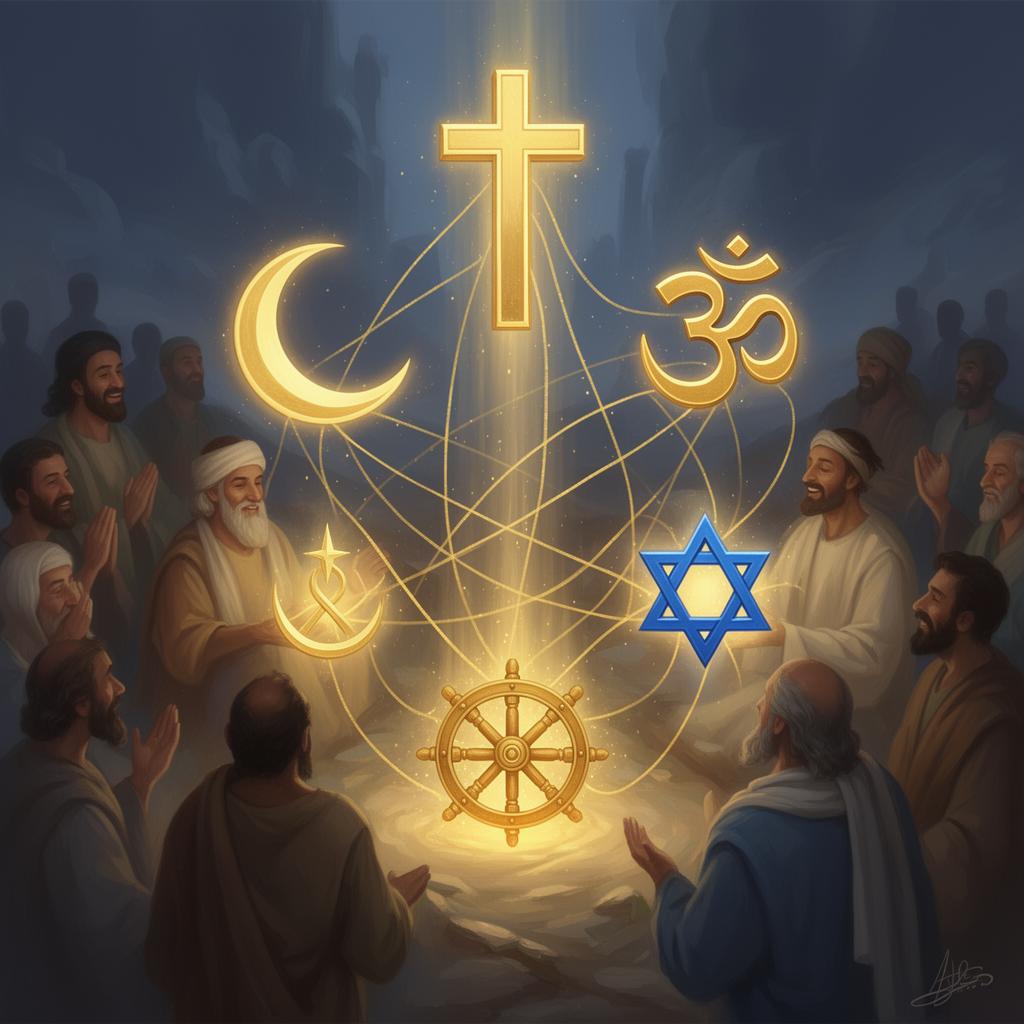
A World Increasingly Connected: Modern Movements & Interfaith Dialogue
The dawn of the 20th century, and certainly the digital age, presented humanity with an unprecedented acceleration of connection, communication, and cultural exchange. Just as geographic barriers crumbled under the march of technology, so too did the perceived isolation of religious and spiritual traditions. The old world, where faith remained largely confined to specific regions and peoples, gave way to a vibrant, often complex, tapestry of beliefs interwoven across continents. This chapter explores some of the most significant spiritual and philosophical currents that emerged or gained prominence in this interconnected era: the Bahá'í Faith, the expansive landscape of New Age spirituality, the thoughtful humanism that seeks meaning outside traditional deities, and the profound, often challenging, movement of interfaith dialogue.
The Bahá'í Faith: One Planet, One People
Amidst the ferment of 19th-century Persia, a new spiritual message began to echo, one that would articulate a vision of humanity unified under a single, loving God. This was the birth of the Bahá'í Faith, a monotheistic religion founded by Baháʼu'lláh. Drawing from the deepest wellsprings of Abrahamic tradition while offering a radical reconceptualization of religious truth, the Bahá'í Faith proclaimed an urgent message of global unity.
Its roots lie in the Bábí movement, initiated in 1844 by Siyyid ʻAlí-Muhammad, who called himself the Báb (the Gate). He proclaimed the imminent arrival of a new prophet, one who would usher in an era of peace and justice. His teachings, considered heretical by the prevailing Shiʻa clergy, led to widespread persecution and his eventual execution in 1850. Among his followers was Mírzá Husayn ʻAlí Núrí, who in 1863 declared himself to be the promised one, "He Whom God Shall Make Manifest." He adopted the title Baháʼu'lláh, meaning "Glory of God."
Baháʼu'lláh’s life was one of relentless exile and imprisonment, enduring hardship for over four decades. Yet, within these trials, he penned an extensive body of sacred writings, including the Kitáb-i-Aqdas (The Most Holy Book), which forms the bedrock of Baháʼí law and teachings. His central teaching is the oneness of God, the oneness of religion, and the oneness of humanity.
Core Principles of the Bahá'í Faith:
- The Oneness of God: There is only one God, the Creator and Sustainer of the universe, who is transcendent and unknowable.
- The Oneness of Religion (Progressive Revelation): All the great religions of the world are seen as stages in a single, unfolding divine plan. Prophets like Abraham, Moses, Zoroaster, Buddha, Jesus, Muhammad, the Báb, and Baháʼu'lláh are manifestations of God, each revealing a portion of divine truth appropriate for their time and place.
- The Oneness of Humanity: All people are fundamentally one, regardless of race, gender, nationality, or social class. Prejudice is seen as a disease, and the establishment of universal peace is a paramount goal.
- Equality of Men and Women: Gender equality is a fundamental principle, with both men and women seen as two wings of humanity, equally essential for flight.
- Harmony of Science and Religion: Truth is one, and genuine science and true religion must always be in harmony. If they appear to conflict, it is due to human interpretation rather than inherent contradiction.
- Elimination of All Forms of Prejudice: Prejudicial beliefs and practices are condemned as barriers to human unity.
- Universal Education: Education is essential for all individuals, promoting intellectual and spiritual growth.
- Independent Investigation of Truth: Individuals are encouraged to seek truth for themselves, rather than blindly following tradition or authority.
- World Peace and a Global Commonwealth of Nations: Baháʼís believe in the establishment of a just and peaceful world order, guided by spiritual principles and a global governing body.
The Bahá'í Faith is unique in its administrative order, led by democratically elected councils at local, national, and international levels, rather than a clergy. Its international governing body, the Universal House of Justice, is headquartered on Mount Carmel in Haifa, Israel, a testament to the community's global scope. With millions of adherents in virtually every country on Earth, the Bahá'í Faith stands as a powerful testament to the possibility of global spiritual unity.
New Age Spirituality: A Kaleidoscope of Belief
The latter half of the 20th century witnessed an explosion of spiritual seeking that defied easy categorization: the New Age movement. Not a single religion with a defined creed or founder, "New Age" is an umbrella term encompassing a vast and eclectic array of spiritual practices, beliefs, and philosophies that emerged predominantly in Western societies, often blending Eastern mystical traditions with Western esotericism, psychology, self-help, and alternative healing modalities.
The term "New Age" itself refers to the astrological concept of the "Age of Aquarius," believed by some to be a forthcoming era of peace, harmony, and spiritual enlightenment following the turbulent "Age of Pisces." This hopeful vision underpinned much of the movement's ethos, promising personal transformation and a collective shift in human consciousness.
Key Themes and Characteristics of New Age Spirituality:
- Holism and Interconnectedness: A fundamental belief that everything in the universe is interconnected – humans, nature, and the cosmos. This often translates to an ecological awareness and respect for the Earth.
- Personal Transformation and Self-Spirituality: Emphasis on individual spiritual experience, personal growth, self-realization, and finding one's own path. It often eschews rigid dogma and external authority in favor of inner wisdom and intuition.
- Eclecticism and Syncretism: A willingness to draw from diverse sources, blending elements from Buddhism, Hinduism, Taoism, Sufism, Native American spirituality, ancient Egyptian beliefs, esoteric Christianity, altered states of consciousness, and even modern science (often interpreted in spiritual ways, like quantum physics).
- Alternative Healing and Wellness: Strong emphasis on holistic health, with practices such as acupuncture, reiki, crystal healing, aromatherapy, yoga, meditation, energy work, and dietary practices.
- Metaphysical Beliefs: Common themes include belief in reincarnation, karma, spirit guides, angels, extraterrestrial intelligence, psychic abilities, and a universal life force or energy.
- Optimism and Personal Empowerment: A general sense of optimism regarding human potential and the ability to manifest one's reality through positive thinking and intention.
- Questioning Traditional Authority: A skeptical stance towards established religious institutions, scientific reductionism, and conventional societal norms.
The New Age movement gained traction through workshops, seminars, books, music, and the burgeoning internet. It offered a spiritual alternative to those disillusioned with organized religion or seeking more experiential and personalized forms of spirituality. Critics often point to its lack of cohesive structure, potential for commercialization, and susceptibility to pseudoscience. However, its influence on mainstream culture, particularly in areas like wellness, mindfulness, and environmental awareness, is undeniable.
New Age spirituality reflects a profound human yearning for meaning, connection, and healing in a rapidly changing world. It highlights a shift from prescribed dogma to personal exploration, from institutional authority to individual experience, and from a fragmented view of reality to a more interconnected, holistic understanding.
Secular Humanism: Meaning Without the Divine
While many in the modern era sought new spiritual pathways, others found meaning and purpose not in the divine, but in humanity itself. Secular humanism represents a philosophical and ethical stance that emphasizes reason, ethics, and justice, while explicitly rejecting supernaturalism and religious dogma. It is not an abandonment of morality or purpose, but rather a re-anchoring of these concepts within a purely human framework.
Humanism has ancient roots, particularly in classical Greek thought and later in the Renaissance, which celebrated human potential and achievements. However, "secular humanism" as a distinct modern movement solidified in the 20th century, largely in response to the rise of scientific inquiry and a growing skepticism towards traditional religious explanations for the universe and human existence.
Core Tenets of Secular Humanism:
- Reason and Critical Inquiry: Humanists advocate for the use of reason, evidence, and the scientific method as the primary means of understanding the world and solving problems. They encourage critical thinking and skepticism towards unsubstantiated claims.
- Ethics and Morality: Morality is seen as originating from human experience, empathy, and a desire to promote well-being for all, rather than from divine command. Ethical principles are derived through rational discourse and consideration of consequences.
- Human Dignity and Value: Every individual possesses inherent worth and dignity. Humanists champion human rights, freedom, and the full development of individual potential.
- Secularism: A commitment to the separation of church and state, ensuring religious freedom for all while maintaining a neutral public sphere.
- Compassion and Social Responsibility: Humanists advocate for social justice, equality, and compassion, believing that humans have a responsibility to address suffering and work towards a better world.
- Focus on This Life: The primary concern is with promoting human flourishing and happiness in this life, rather than focusing on an afterlife.
- Rejection of Supernatural Beliefs: Secular humanism explicitly rejects belief in God, gods, or other supernatural entities, as well as an afterlife or divine intervention.
Humanism often finds its expression in movements advocating for global justice, environmental protection, education, and human rights. It provides a comprehensive worldview for those who find fulfillment in engaging with the world through rational thought, empirical evidence, and a deep commitment to human flourishing. Far from being nihilistic, secular humanism offers a vibrant and often optimistic perspective, believing in humanity's capacity to solve its own problems and create a meaningful existence.
"Humanism is a philosophy of life that affirms our ability and responsibility to lead ethical lives of personal fulfillment that aspire to the greater good of humanity."
– American Humanist Association
It stands as a powerful demonstration that profound moral conviction and a rich, purposeful life do not necessarily require a belief in the supernatural. For many, it offers a coherent and deeply satisfying way to navigate the complexities of modern existence.
Globalization and the Shifting Landscape of Faith
The interconnected nature of the modern world, largely driven by globalization, has profoundly reshaped the landscape of religious practice and belief. The free flow of people, ideas, and information has both challenged and invigorated religious traditions in unprecedented ways.
How Globalization Has Changed Religious Practice:
- Increased Exposure and Pluralism: People are no longer isolated within monocultural religious environments. Cities globally are melting pots of diverse faiths, leading to increased exposure, curiosity, and sometimes tension between different traditions.
- Religious Diasporas and Transnationalism: Migration means that religious communities are no longer confined to their traditional homelands. Hindus practice in Houston, Muslims establish communities in Berlin, and Buddhists build temples in Brazil. These diasporic communities often maintain strong ties with their origins while adapting to new cultural contexts.
- Diffusion of Ideas and Practices: The internet, television, and international travel have facilitated the rapid sharing of religious ideas and practices. Yoga and meditation, once niche Eastern practices, are now mainstream wellness activities in the West. Kabbalah centers attract seekers from diverse backgrounds.
- Rise of Global Religious Movements: Some religious movements, like Pentecostal Christianity or the Bahá'í Faith, have leveraged global networks to spread their message rapidly across continents, establishing a truly global presence.
- Syncretism and Hybridity: The blending of religious elements from different traditions is increasingly common. Individuals might identify with aspects of Buddhism while practicing Christian meditation, or blend indigenous spiritual beliefs with mainstream religions.
- Secularization and De-Traditionalization: While some traditions thrive, globalization can also accelerate secularization in some societies. Exposure to alternative worldviews and scientific advancements can lead individuals away from traditional religious adherence, or lead to a more personalized, less institutionalized approach to spirituality.
- Resurgence of Fundamentalism: In some instances, globalization has contributed to a resurgence of religious fundamentalism, as communities react to perceived threats to their traditions or identity by emphasizing strict adherence to doctrine and practice. This can sometimes lead to conflict.
- Technological Integration: Religious communities increasingly use technology for communication, education, evangelization, and even virtual worship, adapting ancient practices to modern tools.
Globalization, therefore, presents a dual challenge and opportunity for religious traditions: the challenge of maintaining distinct identity in a pluralistic world, and the opportunity for growth, adaptation, and deeper understanding of one's own and others' beliefs.
Interfaith Dialogue: Speaking Across Divides
Perhaps one of the most hopeful and necessary responses to religious pluralism and the tensions it can sometimes create is the rise of the interfaith movement. Interfaith dialogue refers to cooperative, constructive, and positive interaction between people of different religious traditions and spiritual or humanistic beliefs, at both individual and institutional levels, with the aim of mutual understanding, respect, and mutual benefit.
While encounters between different faiths have occurred throughout history, often with conflict, the deliberate and organized pursuit of interfaith dialogue as a movement gained significant momentum in the 20th century, particularly after the horrors of two World Wars and the growing awareness of global interdependence. The World's Parliament of Religions in Chicago in 1893 is often cited as a foundational moment, followed by more sustained efforts in the post-WWII era.
Goals and Approaches of Interfaith Dialogue:
- Mutual Understanding and Respect: To learn about other traditions directly from their adherents, dispelling stereotypes and misconceptions, and fostering genuine respect for their beliefs and practices.
- Building Relationships: To cultivate personal friendships and collegial partnerships across religious lines, fostering a sense of shared humanity.
- Collaborative Action: To work together on common concerns such as poverty, environmental protection, human rights, and peacebuilding, leveraging diverse moral and ethical perspectives for the common good.
- Promoting Peace and Reconciliation: To address religious conflict and foster reconciliation, demonstrating that faith can be a force for peace rather than division.
- Personal and Collective Enrichment: Through encountering other faiths, individuals and communities can deepen their understanding of their own tradition and gain new insights into universal spiritual truths.
- Sharing Wisdom: To exchange wisdom, spiritual practices, and ethical insights for the betterment of all.
Common Ground in Diverse Traditions:
Despite their theological and ritualistic differences, many religious and spiritual traditions share a remarkable amount of common ground, which serves as a fertile basis for interfaith dialogue:
- The Golden Rule: "Do unto others as you would have them do unto you," or its negative formulation, "Do not do unto others what you would not have them do unto you," appears in nearly every major religious tradition.
- Compassion and Empathy: The cultivation of compassion for all beings is a central tenet in Buddhism, Christianity, Islam, Hinduism, and many indigenous traditions.
- Justice and Righteousness: A concern for justice, fairness, and upholding what is right (though interpreted differently) is a universal ethical pillar.
- The Sacredness of Life: Most traditions hold life in high regard, advocating for its protection and condemning violence.
- Stewardship of the Earth: Many traditions, especially indigenous ones, emphasize humanity's role as custodians of creation and the natural world.
- Inner Transformation: The idea that spiritual growth involves an inner journey of self-improvement, purification, and connection to a higher reality (however defined) is widespread.
- Importance of Community: The value of shared community, mutual support, and collective worship or spiritual practice is a cornerstone of most faiths.
- The Search for Meaning and Transcendence: A fundamental human drive to understand one's place in the universe, the purpose of life, and to connect with something beyond the mundane.
Interfaith dialogue is not about converting others, nor is it about blurring religious differences into a bland universalism. Instead, it is about deepening one's own faith through respectful engagement with others, recognizing shared values, and working together for a more peaceful and just world. It acknowledges the beauty of diversity while striving for unity in action. It is a vital pathway for humanity in an increasingly interconnected and pluralistic world.
Conclusion: Towards a Shared Future
The modern era, with its rapid changes and unprecedented global connections, has fostered both fragmentation and integration in the realm of spirituality. From the explicit call for planetary unity sounded by the Bahá'í Faith, to the individualized spiritual quests of the New Age, to the ethical bedrock of secular humanism, humanity is exploring myriad ways to find meaning and purpose. The overarching narrative, however, is one of increasing encounter and the urgent need for understanding. Interfaith dialogue is not merely an optional add-on; it is becoming an essential skill for navigating our shared global village. The wisdom traditions of the past, now accessible to virtually everyone, stand witness to the enduring human search for truth, compassion, and connection. As we move forward, the challenge and the promise lie in honoring our differences while recognizing our profound, shared humanity.
What do these modern movements and interfaith dialogue offer humanity today? They offer a profound lesson in both diversity and unity. They teach us that meaning can be found in countless forms – through revelation, through personal experience, through rational inquiry. They challenge us to move beyond suspicion and fear towards curiosity and empathy. In a world often fractured by misunderstanding, they present a powerful, hopeful vision: that by truly seeing and listening to one another, across the boundaries of belief and unbelief, we can not only coexist but collaboratively build a more just, peaceful, and harmonious future for all.