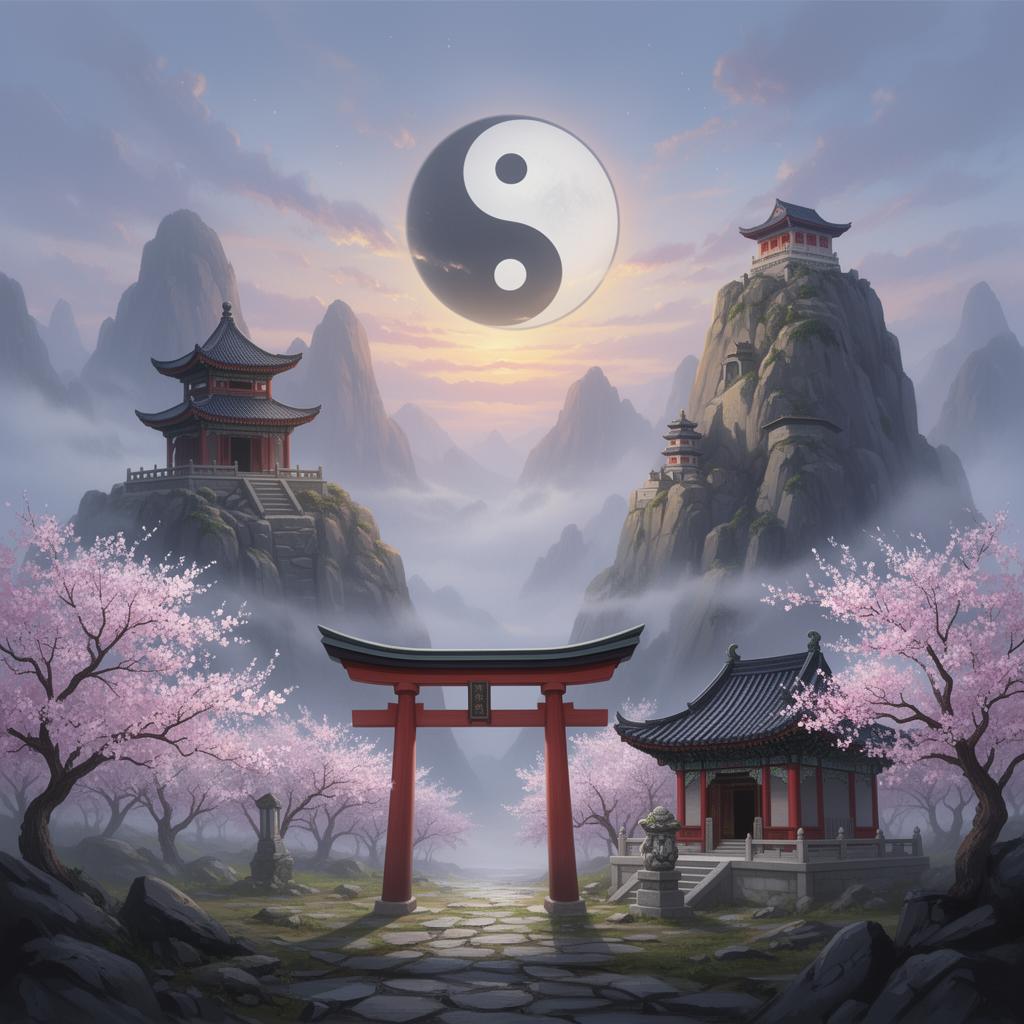
The Harmonious Tapestry: East Asian Traditions
Journeying eastward, our exploration of humanity's spiritual landscape brings us to a rich and intricate world where philosophy, nature, and ancestral reverence weave together into a vibrant tapestry. East Asia, more than a geographical location, represents a unique confluence of wisdom traditions that have shaped not only the lives of billions but also the very fabric of society, art, and governance for millennia. Unlike many traditions we've previously encountered that often center on a single deity or prophet, the spiritual currents of East Asia, particularly Confucianism, Taoism, and Shinto, present a more fluid and integrated approach, often coexisting and influencing each other in profound ways.
Imagine a grand garden where different plants flourish side-by-side, each contributing its unique beauty and fragrance, yet all drawing nourishment from the same soil and sky. This is a fitting metaphor for understanding the interplay of these traditions, especially when Buddhism arrived from India, adding another layer of profound insight and practice. Let us delve into the essence of these foundational East Asian spiritual paths.
Confucianism: The Art of Human Flourishing
To understand China, one must understand Confucius. Born in the 6th century BCE, during a period of intense social and political upheaval known as the Spring and Autumn period, Kong Fuzi (Master Kong) witnessed widespread suffering, chaos, and a decline in moral rectitude. Rather than seeking solace in the supernatural, Confucius turned his gaze inward, towards humanity itself, proposing a system designed to cultivate moral character, foster harmonious social relationships, and establish a just and stable society.
The Philosophy: Jen, Li, and Junzi
Confucianism is not a religion in the conventional Western sense, with gods or an afterlife as its primary focus. Instead, it is a comprehensive ethical and philosophical system that emphasizes human morality, ethics, and the pursuit of personal and governmental propriety. At its heart lies the concept of Jen (often translated as "benevolence," "humanity," or "compassion"). Confucius believed that every human being possesses the innate capacity for Jen, and the goal of life is to fully realize this potential.
The Master said, "A man of Jen is one who, in order to establish himself, seeks to establish others; in order to enlarge himself, seeks to enlarge others."
This universal love and empathy manifest through Li (ritual, propriety, etiquette). Li encompasses all forms of social conduct, from grand ceremonies of state to the humble acts of daily courtesy. It is not mere superficial adherence to rules but a deeply internalized respect for others and for the established order that facilitates harmony. Think of Li as the outward expression of an inner Jen.
The ideal person in Confucianism is the Junzi (often translated as "gentleman" or "superior person"). The Junzi is not defined by birth or social status, but by their moral integrity, wisdom, and commitment to Jen and Li. They are lifelong learners, constantly striving for self-improvement and serving as a moral example for others. The cultivation of the Junzi, from the individual to the ruler, was seen as the pathway to a thriving society.
Sacred Texts: The Five Classics and Four Books
While Confucius himself did not write extensively, his teachings were compiled and expanded upon by his disciples and subsequent generations. The core texts of Confucianism include:
- The Five Classics: These are older texts, some predating Confucius, which he edited and interpreted. They include the Book of Changes (I Ching), Book of History (Shujing), Book of Rites (Liji), Book of Odes (Shijing), and the Spring and Autumn Annals (Chunqiu). These provide historical context, moral principles, and ritual guidelines.
- The Four Books: These are foundational philosophical texts compiled by Neo-Confucians centuries later. They include the Analects (Lunyu), which records Confucius's sayings and conversations; the Mencius (Mengzi), expanding on Confucian principles by one of his most influential followers; the Great Learning (Daxue), focusing on self-cultivation leading to ordered society; and the Doctrine of the Mean (Zhongyong), emphasizing balance and harmony.
Rituals and Practices: Ancestor Veneration and Filial Piety
Confucianism is deeply intertwined with ancestor veneration, a practice born out of filial piety (Xiao) – the profound respect and devotion children owe their parents and elders. This honor extends beyond life, with descendants performing rituals at family altars or ancestral temples, offering food, incense, and prayers. These practices are not about worshipping ancestors as gods, but rather expressing gratitude, maintaining familial connection, and recognizing their role in one's own existence. It reinforces the idea that society is an extension of the family, and respect for authority flows naturally from respect for parents.
Other practices include rituals of courtesy, communal ceremonies, and emphasis on education as a means of moral and intellectual growth. The famous civil service examinations in China, which tested candidates on their knowledge of the Confucian classics, illustrate the profound impact of these ideals on governance and social mobility.
Taoism: The Way of Nature and Effortless Action
Concurrent with the rise of Confucianism, another profound philosophical current emerged in China, one that looked not to the intricate dance of human society for wisdom, but to the majestic and mysterious rhythm of the natural world. This was Taoism, traditionally attributed to the enigmatic figure of Laozi (Old Master), who is said to have lived around the same time as Confucius.
The Philosophy: Tao, Wu Wei, and the Yin and Yang
At the heart of Taoism is the concept of the Tao (pronounced "Dao," meaning "Way" or "Path"). The Tao is not a god or a specific dogma, but rather the ultimate, ineffable principle that underlies and permeates all existence. It is the spontaneous, ever-flowing, unnamable source and order of the universe, beyond human comprehension or definition. The goal of Taoist practice is to align oneself with the Tao, to live in harmony with its flow.
The Tao that can be told is not the eternal Tao; The name that can be named is not the eternal Name.
This alignment is achieved through Wu Wei, often translated as "non-action" or "effortless action." This does not mean inaction or laziness, but rather acting in accordance with the natural flow, without forced effort, resistance, or manipulation. It's about letting go of egoic desires and allowing things to unfold naturally, much like water shapes the landscape not through force, but through patient, persistent flow. Wu Wei encourages spontaneity, flexibility, and living authentically in the present moment.
Taoism also introduces the profound concept of Yin and Yang – two complementary, interdependent cosmic forces that represent all dualities in the universe: light and dark, male and female, hot and cold, active and passive. These are not opposing forces in conflict, but rather two halves of a greater whole, constantly transforming and balancing each other. The famous Yin and Yang symbol beautifully illustrates this dynamic interplay, with a small circle of one color within the larger area of the other, signifying that each contains the seed of its opposite. Understanding this balance is crucial to living in harmony with the Tao.
Sacred Texts: Tao Te Ching and Zhuangzi
The foundational text of philosophical Taoism is the Tao Te Ching (The Classic of the Way and Its Power), traditionally attributed to Laozi. This short but profound work, composed of poetic verses and aphorisms, expresses the elusive nature of the Tao, the principles of Wu Wei, and the importance of simplicity, humility, and returning to nature. It is a book of paradoxes, inviting readers to look beyond conventional wisdom.
Another seminal text is the Zhuangzi, attributed to the sage Zhuang Zhou (369–286 BCE). Filled with allegorical stories, fables, and humorous anecdotes, the Zhuangzi further explicates Taoist philosophy, often through imaginative and provocative narratives that challenge conventional thought, emphasize the relativity of knowledge, and celebrate freedom and unconventional living.
Rituals and Practices: Alchemy, Meditation, and Nature Devotion
Over time, Taoism evolved beyond pure philosophy into a diverse religious tradition incorporating a Pantheon of deities, ancestral veneration, and elaborate rituals aimed at achieving longevity, immortality, or heightened spiritual awareness. Religious Taoism includes various schools and practices, often involving:
- Inner Alchemy (Neidan): A complex set of meditative and physiological practices aimed at cultivating inner energy (qi), transforming the body, and achieving spiritual immortality.
- Exorcism and Healing: Taoist priests often perform rituals to ward off evil spirits, heal illnesses, and bring blessings.
- Feng Shui: The ancient art and science of arranging living spaces in harmony with the flow of qi to promote health, prosperity, and well-being.
- Nature Devotion: Reverence for mountains, rivers, and specific sacred sites, seen as places where the Tao's energy is particularly potent.
- Meditation and Chanting: Practices for cultivating inner peace, clarity, and connecting with the cosmic flow.
Shinto: The Way of the Gods in Japan
Crossing the East China Sea, we arrive in Japan, home to a unique and ancient indigenous spiritual tradition known as Shinto (literally, "the Way of the Gods" or "the Way of the Kami"). Unlike Confucianism or Taoism, which originated as philosophical schools, Shinto is deeply rooted in the animistic beliefs and practices of prehistoric Japan, revolving around the veneration of Kami.
The Philosophy: Kami and Musubi
Shinto has no founder, no definitive sacred scriptures like the Bible or Quran, and no explicit moral code in the same way as Confucianism. Instead, it is a spiritual path intrinsically linked to the land, people, and community of Japan. Its fundamental concept is Kami. Kami are not singular, omnipotent gods in the Western sense, but rather sacred spirits, deities, or powers that reside in and animate natural phenomena, geographical features, and even exceptional human beings or ancestors.
Kami can be found in a majestic mountain, a waterfall, a powerful tree, a unique rock formation, or even the sun (Amaterasu Omikami, the ancestral kami of the Imperial family). They embody both awe-inspiring power and gentle presence, embodying the vitality and spiritual essence of the world. Ancestors, particularly those who have passed on and are recognized for their noble deeds, can also become Kami.
The goal of Shinto practice is to live in harmony with the Kami, to honor them, and to foster a sense of gratitude and purity in one's life. This leads to Musubi, the Japanese concept of a creative and harmonizing power, a spiritual generator that unites and allows things to grow and develop. It underscores the interconnectedness of all things and the life-giving energy imbued by the Kami.
Sacred Texts: Kojiki and Nihon Shoki
While not "scriptures" in the prescriptive sense, two ancient chronicles preserved important myths, legends, and historical narratives that inform Shinto worldview: the Kojiki (Records of Ancient Matters, 712 CE) and the Nihon Shoki (Chronicles of Japan, 720 CE). These texts describe the creation of Japan by the kami Izanagi and Izanami, the birth of the sun goddess Amaterasu, and the divine lineage of the Japanese imperial family, thereby linking the spiritual and political leadership.
Rituals and Practices: Purity, Festivals, and Shrines
Purity (Harae) is a central theme in Shinto. Before approaching Kami, individuals perform ritual purification, often by washing their hands and rinsing their mouths. This internal and external cleansing is called Misogi or Harai. Purity is seen as the natural state, while defilement (Kegare) through illness, death, or moral transgression, requires purification before resuming harmonious relations with the Kami.
Shinto practices revolve around the Jinja (shrines), which serve as homes for the Kami. These are typically serene, natural settings marked by a Torii gate, which signifies entry into a sacred space. Worship at a shrine involves a simple yet profound ritual:
- Passing through the Torii.
- Purifying oneself at the water font (Temizuya).
- Approaching the main hall, offering a coin, ringing a bell or clapping one's hands twice (to get the Kami's attention), bowing twice, offering a prayer, and bowing once more.
Festivals (Matsuri) are vibrant and essential expressions of Shinto, celebrated throughout the year. These events often involve parades, music, dance, and offerings to thank Kami for harvests, pray for blessings, or celebrate community. They are joyous communal affairs that reinforce social bonds and connections to the natural world. Another important practice is offering Omikuji (fortune slips) or writing prayers on Ema (wooden votive tablets) at shrines.
Coexistence and Interaction with Buddhism and Other Traditions
One of the most remarkable aspects of East Asian spirituality is its capacity for syncretism and coexistence. When Buddhism arrived in China from India around the 1st century CE, it encountered well-established Confucian and Taoist currents. Rather than outright conflict, a dynamic process of adaptation and assimilation began.
In China, Buddhism profoundly influenced Taoism and Confucianism, and vice-versa. Chan Buddhism (later known as Zen in Japan), with its emphasis on meditation and direct experience, resonated with Taoist principles of effortless action and harmony with nature. Neo-Confucianism, a revitalization of Confucian thought in the Song Dynasty (960-1279 CE), directly incorporated Buddhist and Taoist metaphysical and cosmological ideas, creating a more comprehensive worldview that addressed questions of cosmology, ethics, and human nature.
In Japan, the arrival of Buddhism in the 6th century CE led to a remarkable fusion with indigenous Shinto. This blending, known as Shinbutsu-shūgō, saw Kami being interpreted as manifestations of Buddhas and Bodhisattvas, and Buddhist temples being built within Shinto shrines, or vice-versa. People would worship at both Shinto shrines and Buddhist temples, often for different purposes – Shinto for life events like birth and marriage, and Buddhism for death and the afterlife. This syncretism demonstrates a profound cultural adaptability and the ability to embrace multiple spiritual perspectives simultaneously without necessarily seeing them as contradictory.
Even today, it is common for individuals in China, Japan, Korea, and other East Asian nations to draw upon these traditions selectively. A person might live by Confucian ethics in their professional life, practice Taoist meditation for personal well-being, visit a Shinto shrine for a blessing, and participate in Buddhist funeral rites for a loved one. There's often a pragmatic rather than dogmatic approach, where the value of a tradition is found in its utility for specific aspects of life rather than adherence to an exclusive belief system.
This harmonious interaction has created a spiritual landscape that is immensely rich and complex, where each tradition offers a distinct yet complementary lens through which to understand reality, cultivate virtue, and find meaning.
What East Asian Traditions Offer Humanity Today
In our modern, often fragmented world, the ancient wisdom of East Asian traditions offers profound insights. Confucianism reminds us of the perennial importance of ethics, education, and the cultivation of character for building strong families and a just society. Its emphasis on empathy (Jen) and proper conduct (Li) provides a timeless framework for healthy human relationships and good governance, urging us to look beyond individualistic desires towards collective well-being.
Taoism, with its celebration of nature and the principle of Wu Wei, offers a vital antidote to the relentless pace and artificiality of modern life. It invites us to reconnect with the natural world, to embrace simplicity, and to find peace in spontaneous, effortless action rather than constant striving. The concept of Yin and Yang teaches us to embrace paradox, to see the interconnectedness of opposites, and to seek balance in a world often dominated by extremes.
Shinto, deeply rooted in reverence for the natural world and the spirit of place (Kami), fosters an ecological consciousness that is ever more critical today. It reminds us to see the sacred in the mundane, to appreciate the beauty and power of our environment, and to approach life with purity, gratitude, and a sense of belonging to a community that includes both the living and the spiritual ancestors. Its vibrant festivals offer models for communal celebration and connection that strengthen social bonds.
Collectively, these traditions, often enhanced by the contemplative depth of Buddhism, present a worldview that values harmony, balance, compassion, and a holistic understanding of existence. They demonstrate that spiritual paths need not be mutually exclusive but can enrich each other, offering diverse avenues for human flourishing and a deeper connection to ourselves, our communities, and the awesome mystery of the cosmos.