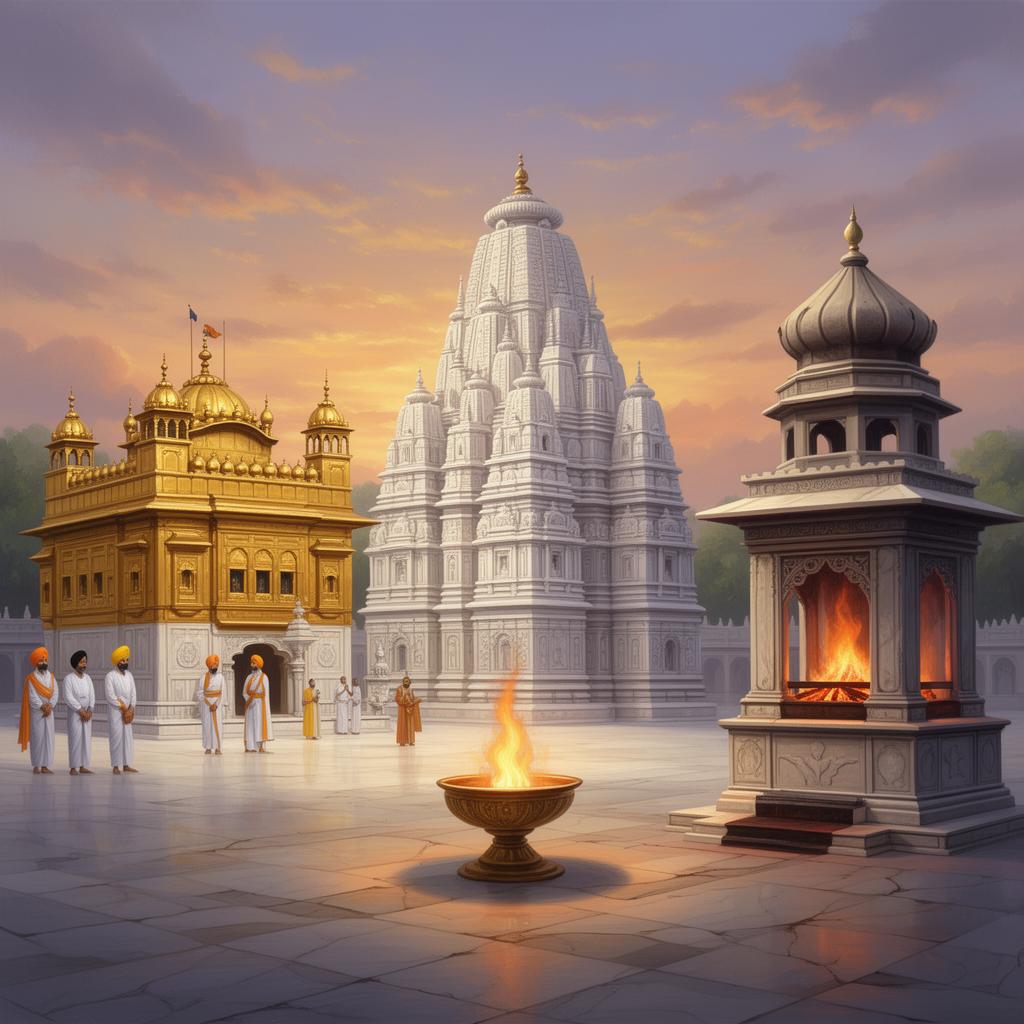
The Enduring Flames: Sikhism, Jainism, and Zoroastrianism
In the vast tapestry of human spirituality, some threads gleam with a particular brilliance, distinct yet interconnected, illuminating paths less trodden but profoundly inspiring. This chapter invites you to embark on a journey into three such traditions, each a testament to the enduring human quest for truth, righteousness, and a connection to the divine: Sikhism, Jainism, and Zoroastrianism. Though born in different epochs and geographical landscapes, they share a common spirit of ethical living, devotion, and a profound respect for the sanctity of existence. They remind us that the divine speaks in many tongues, and the path to enlightenment is as diverse as humanity itself.
The Path of the Lion-Hearted: Sikhism
Imagine a time when India was a crucible of diverse faiths, often clashing, sometimes coexisting. From this vibrant yet turbulent landscape, a new spiritual path emerged in the 15th century, one that championed equality, selfless service, and an unwavering devotion to the One Creator. This was Sikhism, a faith founded by Guru Nanak, a visionary who sought to bridge divides and reveal a simpler, purer truth.
Guru Nanak: The Dawn of a New Vision
Born in 1469 in Talwandi (now Nankana Sahib, Pakistan), Guru Nanak Dev Ji’s early life showed signs of an exceptional spiritual awareness. He questioned rituals and caste distinctions, seeking a direct and unmediated experience of the divine. At the age of 30, he had a profound spiritual revelation while bathing in the Kali Bein river. He emerged proclaiming, "There is no Hindu, there is no Muslim, there is only one God and all are His children." This simple yet revolutionary statement laid the foundation for Sikhism.
Guru Nanak embarked on extensive journeys, known as "Udasis," traveling far and wide, engaging in dialogues with ascetics, scholars, and common people from various traditions. He taught of Ik Onkar – the Singular Creator – and emphasized the importance of three core principles:
- Naam Japna: Meditating on God's name and presence.
- Kirat Karni: Earning an honest living through hard work and creativity.
- Vand Chakna: Sharing one's earnings and resources with those in need.
His teachings advocated for a householder's life, rejecting asceticism and monasticism, and promoting active engagement with the world while remaining spiritually detached. He believed that the divine could be experienced within, through righteous living and devotion, rather than through external rituals or dogmas.
The Ten Gurus and the Birth of the Khalsa
Sikhism flourished under a succession of ten Gurus, each building upon the teachings of their predecessors. The Gurus were not seen as manifestations of God, but as spiritual guides and exemplars. They refined doctrines, composed hymns, and established institutions that would define the Sikh way of life.
- Guru Arjan Dev Ji: The 5th Guru, he compiled the Adi Granth, the holy scripture of Sikhism, incorporating not only the teachings of the Sikh Gurus but also hymns from Hindu and Muslim saints who shared similar spiritual insights. His martyrdom at the hands of the Mughal emperor marked a turning point, leading to a greater emphasis on defending the faith.
- Guru Gobind Singh Ji: The 10th and final human Guru,
he transformed the Sikh community into the Khalsa in 1699.
The Khalsa is a spiritual brotherhood and sisterhood,
dedicated to fighting injustice and upholding righteousness.
Members of the Khalsa outwardly express their commitment
through the "Five Ks" (Panj Kakare):
- Kesh: Uncut hair, symbolizing acceptance of God's will.
- Kangha: A small comb, for cleanliness and discipline.
- Kara: A steel bracelet, symbolizing unbroken connection to God and community.
- Kachera: Special undergarments, representing chastity and readiness.
- Kirpan: A ceremonial sword, as a symbol of dignity, self-defense, and the fight against injustice.
The Guru Granth Sahib: The Living Word
The Guru Granth Sahib is far more than a holy book to Sikhs; it is revered as the living embodiment of the Gurus' teachings, the ultimate spiritual guide. It is a voluminous scripture, meticulously compiled and preserved, written in Gurmukhi script.
"The Word is the Guru, and the Guru is the Word. The Word is full of all spiritual powers. If the disciple acts according to what the Word says, he will surely be saved."
- Guru Ram Das (Guru Granth Sahib, Ang 982)
The hymns (Shabads) within the Guru Granth Sahib are poetic expressions of divine love, philosophical insights, and ethical guidance. They are sung daily in gurdwaras (Sikh temples) and recited in homes, forming the core of Sikh worship and spiritual practice. Its inclusive nature, containing the wisdom of various saints, underscores the Sikh belief in the universality of truth.
Sikh Beliefs and Practices
At the heart of Sikhism lies the belief in one God (Ik Onkar), who is formless, eternal, and transcendent, yet also immanent within creation. Sikhs believe in:
- Equality: All humans are equal, regardless of caste, religion, gender, or race. The institution of the Langar (community kitchen) where all sit together and share a free meal is a powerful expression of this principle.
- Selfless Service (Seva): Dedication to serving others without expectation of reward. This can involve physical labor, financial contributions, or sharing knowledge.
- Truthful Living: Honesty, integrity, and ethical conduct in all aspects of life.
- Rejection of Idolatry and Superstition: Direct worship of God, without intermediaries or elaborate rituals.
- Karma and Reincarnation: Belief in the cycle of birth, death, and rebirth, influenced by one's actions, with the ultimate goal of merging with the divine.
Sikh life is characterized by devotion, meditation (Simran), and participation in the community. The turban worn by Sikh men and some Sikh women is not just a cultural symbol but a religious commitment, representing discipline, integrity, and spiritual sovereignty. Sikhs are known for their courage, generosity, and commitment to justice, often leading humanitarian efforts and standing up for the oppressed.
The Path of Non-Violence: Jainism
Stepping back in time to ancient India, around the 6th century BCE, we encounter another profound spiritual movement: Jainism. Emerging concurrently with Buddhism, Jainism offers a path of radical non-violence (ahimsa), self-control, and asceticism as the means to liberate the soul from the cycle of rebirth (samsara). It is a tradition born from deep contemplation on the suffering inherent in existence and the profound interconnectedness of all life.
Mahavira: The Great Hero
While the origins of Jainism trace back further, to a lineage of 23 previous Tirthankaras (ford-makers), it was Vardhamana Mahavira (c. 599-527 BCE) who is considered the 24th and last Tirthankara of this age, and the one who solidified and widely promulgated Jain teachings. Born into a royal family, Mahavira’s early life was one of privilege, but he harbored a deep spiritual yearning. At the age of 30, he renounced his worldly life, his family, and all possessions, embarking on a journey of intense asceticism and meditation.
For twelve-and-a-half years, Mahavira practiced extreme self-discipline, fasting, meditating in harsh conditions, and enduring physical hardships. His quest was to conquer his passions, desires, and attachments, and to achieve perfect knowledge and liberation. This arduous journey culminated in his enlightenment (kevala-jnana), where he attained omniscience. He spent the next 30 years teaching his philosophy to a wide range of people, laying the groundwork for the Jain community.
The Three Jewels (Triratna) and Ahimsa
The core of Jainism is encapsulated in its "Three Jewels" of right conduct, beliefs, and knowledge:
- Right Faith (Samyak Darshana): A correct and rational understanding of Jain philosophy and scriptures.
- Right Knowledge (Samyak Gyana): Accurate knowledge of the universe, the self, and liberation, free from doubt.
- Right Conduct (Samyak Charitra): Living according to ethical principles, especially the five vows.
Central to right conduct, and indeed to all of Jainism, is the principle of Ahimsa (non-violence). This is not merely the absence of violent action but a profound respect for every living being, from humans and animals to plants and even microscopic organisms. Jains believe that all beings possess a soul (jiva) and are therefore worthy of reverence.
"A living body is not merely an integration of cells and tissues but an embodiment of the soul. It is a temple, not a prison. Therefore, never hurt anyone. To take a life is to cause the utmost pain."
- Mahavira
This commitment to ahimsa manifests in various aspects of Jain life:
- Vegetarianism/Veganism: Strict adherence to a lacto-vegetarian diet, often extending to veganism, to minimize harm to animals.
- Careful Living: Jains may avoid consuming root vegetables (as harvesting them kills the plant and disturbances in soil might kill insects), filter drinking water, and sweep the ground before them with a whisk to avoid inadvertently harming insects.
- Peaceful Professions: Encouragement of professions that do not involve violence towards any living being.
The Five Great Vows (Mahavratas)
Jain renunciants (monks and nuns) commit to observing the Five Great Vows with utmost rigor. Lay Jains also strive to observe them, though often with less stringent application:
- Ahimsa (Non-violence): Not to intentionally cause harm to any living being.
- Satya (Truthfulness): To speak only the truth, in a gentle and beneficial manner.
- Asteya (Non-stealing): Not to take anything that is not freely given.
- Brahmacharya (Chastity): For monks and nuns, complete celibacy; for lay Jains, fidelity to one's partner.
- Aparigraha (Non-possessiveness/Non-attachment): Limiting possessions and detaching oneself from worldly desires and attachments.
Jain Beliefs and Practices
Jainism is an atheistic religion in the sense that it does not believe in a creator God or divine intervention in human affairs. Instead, it posits a self-regulating universe governed by universal laws. The focus is on individual responsibility for one's actions (karma) and the inherent potential of every soul to achieve liberation (moksha).
- Karma: Unlike other traditions where karma is often seen as a subtle force, Jains believe karma is a subtle substance that adheres to the soul based on one's actions, weighing it down and preventing its ascent. Good karma leads to favorable rebirths, but only through purifying all karma can liberation be achieved.
- Jiva and Ajiva: Jain philosophy differentiates between Jiva (conscious, living beings or souls) and Ajiva (non-conscious, non-living matter like space, time, matter, and motion). The goal is for the jiva to free itself from the ajiva.
- Asceticism and Fasting: Self-control and ascetic practices are crucial to burn off accumulated karma. Fasting is a common practice, both for spiritual purification and as a form of self-discipline.
- Digambara and Svetambara: The two main sects of Jainism, differing primarily in the interpretation of ascetic practices. Digambara (sky-clad) monks traditionally practice nudity, symbolizing complete non-attachment, while Svetambara (white-clad) monks wear simple white clothing.
Jain worship often involves honoring the Tirthankaras through images, meditation, and reciting sacred texts in temples (derasars). The ultimate aim is to perfect the soul, shedding all karmic bonds, and achieving a state of eternal bliss and omniscience (Siddha Loka), dwelling at the apex of the universe, beyond the cycle of rebirth.
The Good Mind and the Sacred Fire: Zoroastrianism
Journey now to ancient Persia, to a world where vast empires rose and fell, and where the cosmic battle between truth and falsehood was understood to play out in every human heart. Here, thousands of years ago, a prophet named Zarathushtra (Greek: Zoroaster) revolutionized religious thought, giving birth to one of the world's oldest monotheistic religions: Zoroastrianism. Though small in number today, its influence on other major religions, including Judaism, Christianity, and Islam, is profound and undeniable.
Zarathushtra: The First Prophet of Monotheism
The exact dates of Zarathushtra's life are a subject of scholarly debate, ranging from 1700 BCE to 600 BCE, placing him perhaps alongside or even pre-dating the Vedic seers of India and Abraham. He was born in what is now northeastern Iran or Afghanistan. As a young man, he questioned the polytheistic and ritualistic practices of his contemporary Indo-Iranian religion, seeking a deeper spiritual truth. At the age of 30, he experienced a series of divine revelations, through which he was called by Ahura Mazda (Wise Lord) to preach a new message.
Zarathushtra’s teachings were revolutionary. He proclaimed that there was one supreme, uncreated God, Ahura Mazda, who is benevolent, omniscient, and the source of all goodness. He challenged the prevailing notion of multiple deities and emphasized individual free will and moral choice, a concept far ahead of its time. His message was initially met with resistance but eventually gained traction, finding a powerful convert in King Vishtaspa, whose patronage helped establish Zoroastrianism as a dominant religion in the Achaemenid Persian Empire.
Asha and Druj: The Cosmic Battle
At the core of Zoroastrian theology is the concept of a cosmic dualism: the eternal struggle between two opposing forces.
- Asha (Truth/Order/Righteousness): Represented by Ahura Mazda, Asha embodies all that is good, constructive, and life-affirming. It encompasses cosmic order, moral righteousness, and spiritual purity.
- Druj (Lie/Disorder/Falsehood): Represented by Angra Mainyu (Evil Spirit) or Ahriman, Druj embodies all that is evil, destructive, and chaos-inducing.
Zarathushtra taught that Ahura Mazda is not responsible for evil. Instead, evil originates from Angra Mainyu, an independent spirit who chose falsehood. Humanity stands in the middle of this cosmic battle, endowed with free will to choose between Asha and Druj. Every thought, word, and deed contributes to the triumph of one over the other. This ethical dualism places a profound responsibility on each individual.
"There are two primal spirits, which in vision, are found to be twins, the better and the worse, in thought and word and action. Between these two, the wise choose rightly, not so the foolish."
- Zarathushtra (Gathas, Yasna 30.3)
Fire Worship and Sacred Elements
Fire plays a central and symbolic role in Zoroastrian rituals, often mistakenly leading to the label "fire worshipers." However, fire is not worshipped as a deity itself. Rather, it is revered as a sacred symbol of Ahura Mazda, representing:
- Purity: Fire is seen as a purifying agent, cleansing away defilement.
- Truth and Light: It symbolizes the divine light and wisdom of Ahura Mazda, dispelling darkness and ignorance.
- Ever-present Energy: The constant flame in a fire temple reminds adherents of the eternal, unseen presence of God.
Alongside fire, other natural elements like water, air, and earth are also held sacred, seen as creations of Ahura Mazda and therefore deserving of reverence and protection. This ecological awareness is a timeless aspect of Zoroastrianism.
Zoroastrian Beliefs and Practices
Zoroastrianism is rich in its ethical framework and eschatology:
- Good Thoughts, Good Words, Good Deeds (Humata, Hukhta, Hvarshta): This triad forms the fundamental ethical principle, guiding all actions and intentions.
- Immortality of the Soul: Zoroastrians believe in an afterlife, where the soul is judged based on its earthly choices and either crosses the Chinvat Bridge (Bridge of the Separator) to paradise or faces a period of purification.
- Frashokereti (Renovation of the World): The belief in a final cosmic renovation, where evil will be utterly defeated, and all of creation will achieve a perfect, immortal, and incorruptible state under Ahura Mazda. This concept of linear time and a final judgment was highly influential on Abrahamic religions.
- Purity and Pollution: Adherence to rituals and traditions concerning purity, especially when dealing with death, as death is seen as the temporary triumph of Angra Mainyu.
- Prayer and Rituals: Daily prayers are offered, often facing a source of light (the sun, a lamp, or a sacred fire), and various ceremonies mark life cycle events.
- Community (Anjuman): The Zoroastrian community, though small, is tightly knit, with strong emphasis on family and mutual support. The Parsis in India and the Iranians (Zartoshti) are the two primary surviving communities.
The scriptures of Zoroastrianism are collectively known as the Avesta, with the Gathas (hymns attributed to Zarathushtra himself) forming its oldest and most sacred part, expressing his poetic and philosophical vision.
What These Traditions Offer Humanity Today
These three distinct paths – Sikhism, Jainism, and Zoroastrianism – though numerically smaller than some global religions, offer invaluable wisdom and inspiration to our contemporary world. They stand as powerful reminders of humanity's capacity for profound ethical living and spiritual insight.
- Sikhism champions radical equality, selfless service, and community (Langar), providing a powerful antidote to discrimination and division. Its emphasis on honest labor and sharing wealth offers a compelling model for economic justice. The Khalsa's commitment to defending righteousness reminds us of the enduring need for courage in the face of injustice.
- Jainism, with its unwavering commitment to ahimsa, is a beacon in an increasingly violent world. Its ecological consciousness and profound respect for all living beings offer critical lessons in environmental stewardship and ethical consumption. The Jain emphasis on self-control and detachment provides a spiritual compass in a consumerist society.
- Zoroastrianism, one of humanity's earliest ethical monotheisms, places immense value on individual moral choice and responsibility. Its clear articulation of good thoughts, words, and deeds provides a simple yet profound framework for ethical living. The cosmic battle between Asha and Druj invites us to actively choose goodness in a complex world, and its reverence for pure elements anticipates modern environmental concerns.
In their quiet resilience, their deep ethical foundations, and their profound spiritual depths, Sikhism, Jainism, and Zoroastrianism continue to enrich the human spiritual landscape, offering pathways to peace, purpose, and a more just and compassionate world.