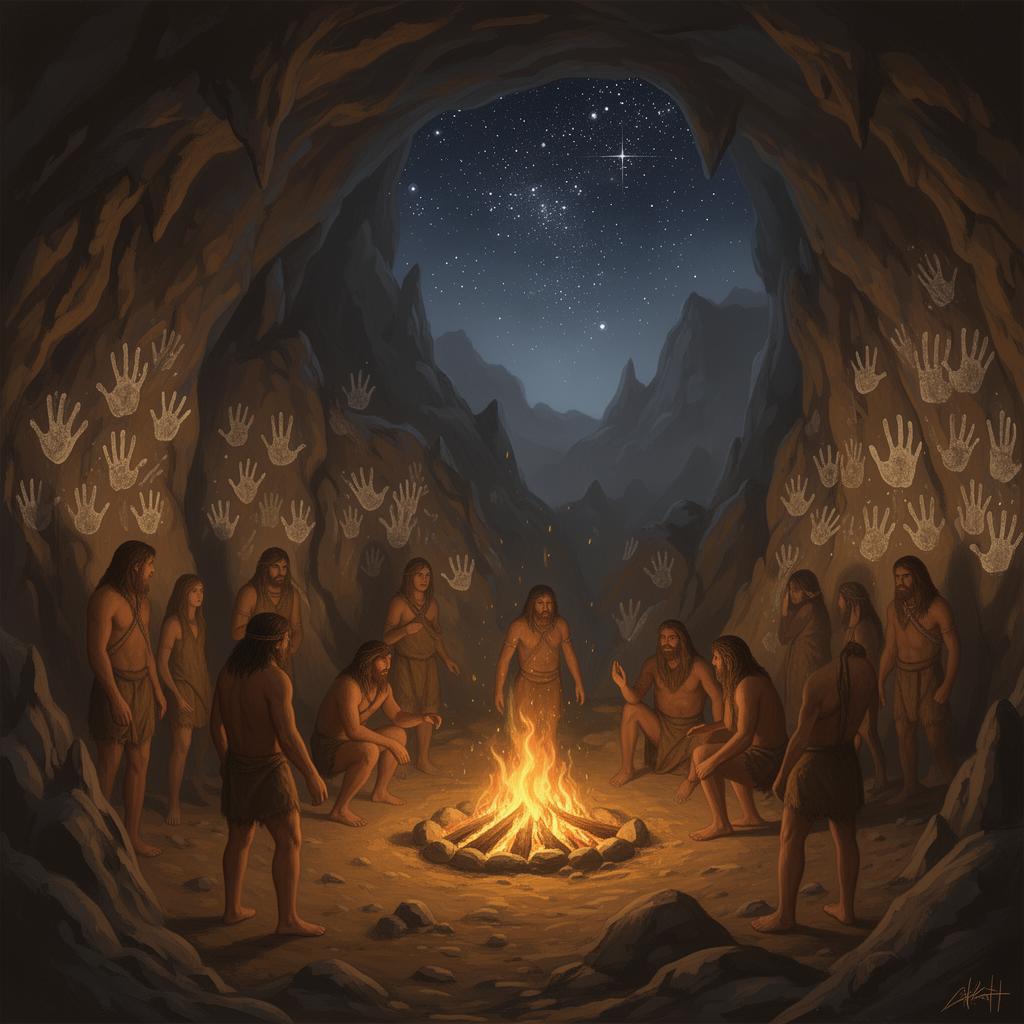
The Whispering Wild: Early Stirrings of the Sacred
Imagine, if you will, a world untamed and unburdened by skyscrapers or smartwatches. A world where the rustle of leaves was a story, the roaring river a powerful voice, and the shimmering stars a vast, unknowable tapestry. This was the canvas upon which humanity first began to paint its understanding of the sacred – a journey that stretches back tens of thousands of years, long before the earliest written word, into the enigmatic depths of prehistory. It was a time when survival was a daily struggle, yet even amidst the hunt for food and the fight for shelter, something profound was stirring within the human heart: a yearning for meaning, a recognition of something beyond the tangible.
Our earliest ancestors lived in intimate communion with the natural world. Their lives were interwoven with the cycles of the seasons, the behavior of animals, the generosity and scarcity of the land. In this profound interconnectedness, it was perhaps inevitable that they began to perceive a liveliness, a spirit, in everything around them. This is the essence of what scholars call animism – the belief that spirits or souls inhabit natural objects, phenomena, even landscapes. The towering oak wasn't just wood and leaves; it had a spirit, a presence. The gushing waterfall wasn't merely water cascading; it was alive, powerful, perhaps benevolent or dangerous. The very earth beneath their feet thrummed with unseen energies.
This animistic worldview wasn't a simplistic misunderstanding of nature; it was a sophisticated way of relating to it. If the forest had a spirit, one might placate it before felling a tree. If the river had a soul, one might offer thanks before drinking from it. This fostered a deep respect, an inherent reciprocity with the environment, born not just of practicality but of spiritual understanding. It meant that every rustle in the grass, every shadow cast by the moon, could signify a spiritual encounter. The world was alive, vibrant, and imbued with intentionality.
Shamanic Journeys: Bridging Worlds
Within these animistic societies, certain individuals emerged who possessed extraordinary abilities – the power to navigate this spirit-filled world, to communicate with its inhabitants, to heal, and to guide. These were the shamans, the medicine men and women, the mystics of the Paleolithic era. The word "shaman" itself comes from the Evenki people of Siberia, meaning "one who knows." And indeed, they knew things – things unseen, unheard by the ordinary eye and ear.
The role of the shaman was pivotal. They were the intermediaries between the human realm and the spirit world. Through ecstatic trance states, often induced by drumming, rhythmic chanting, dancing, fasting, or sometimes psychoactive plants, shamans would embark on spiritual journeys, their souls believed to travel to other dimensions. In these altered states, they sought guidance from animal spirits, ancestral spirits, or deities to avert misfortune, heal illness, locate game, or interpret dreams.
Archaeological evidence hints at the practices of shamans across diverse cultures and continents. Cave paintings depicting therianthropes – human-animal hybrids – are often interpreted as representations of shamans in their spirit forms or their animal helpers. Elaborate burial sites containing ritual objects like antlers, feathers, and ochre, found alongside human remains, further suggest the importance and unique status of these spiritual leaders.
“The shaman is the great specialist in the human soul.”
Eliade’s profound observation underscores that the shaman's quest was ultimately about the human condition – navigating suffering, seeking meaning, and reconciling the inner self with the vastness of the cosmos. Their rituals were often performances, intricate dances and songs designed to bring their community into alignment with the spiritual forces perceived all around them. The rhythmic pulse of ancient drums might have been the heartbeat of entire communities, guiding them through darkness and uncertainty.
Honoring Those Who Came Before: The Threads of Ancestor Worship
But the spiritual landscape wasn't just populated by nature spirits and animal guides. A profound reverence was also extended to those who had passed beyond the veil. Ancestor worship, a practice that endures in many forms even today, has roots stretching deep into prehistory. It reflects a fundamental human recognition of continuity, a belief that the spirits of the deceased remain connected to the living, influencing their lives, and requiring respect and remembrance.
The earliest clear evidence of ancestor veneration comes from intentional burials. While some hominids simply abandoned their dead, early modern humans, and even Neanderthals, began to inter their deceased with care and ceremony. Pit burials containing bodies adorned with ochre (a natural pigment often associated with blood and life), accompanied by tools, shells, or flowers, speak volumes. These weren't mere disposals; they were rituals, expressions of grief, but also hope and a belief in some continuation of existence.
The famous "Flower Burial" at Shanidar Cave, Iraq, dating back around 60,000 years, where a Neanderthal individual was buried with large clumps of flowering plants, suggests a ritualistic farewell, imbued with meaning. While the interpretation is debated, the deliberate act of placing flowers with the dead points towards something beyond the purely pragmatic.
As societies grew and settled, ancestor worship often evolved into more formalized practices. Family lines became important, and the deceased members were seen as guardians, intercessors, or even minor deities who could bless or curse the living. Offerings were made at grave sites, stories told, and rituals performed to ensure their benevolent presence and continued support. This created a powerful sense of lineage, identity, and shared history, binding communities together not just horizontally across the living, but vertically through generations.
Cave Art: The Galleries of the Soul
Perhaps some of the most breathtaking and enduring testaments to early human spirituality are the incredible cave paintings found across the globe, from the vivid depictions in Lascaux and Chauvet in France to the intricate rock art of Australia and Africa. These aren't simply ancient doodles or primitive art; they are profound expressions of a complex spiritual world, often located in the deepest, most inaccessible parts of the caves, suggesting sacred spaces, sanctuaries for ritual and introspection.
Imagine, entering a vast, echoing cavern, lit only by flickering torchlight. On the undulating walls, magnificent beasts come to life – bison, horses, mammoths, deer – rendered with astonishing skill and anatomical accuracy. But these aren't merely hunting manuals. Many theories abound regarding their purpose: hunting magic (sympathetically drawing the animal's spirit closer), fertility rites, or perhaps even records of shamanic visions.
The "Great Bull" of Lascaux, with its powerful, commanding presence, could represent a primordial spirit, a deity of the hunt, or an embodiment of the wilderness itself. The more abstract symbols, handprints, and geometric patterns often accompanying the animal figures might be esoteric signs, parts of a lost symbolic language, or representations of the altered states of consciousness experienced by shamans.
The very act of creating these paintings was likely a spiritual endeavor. The pigments – ground minerals like ochre, charcoal, and manganese – were carefully prepared. The damp, dark, silent environment of the deep caves would have been conducive to a sense of awe and reverence. The artists may have been shamans themselves, or individuals deeply attuned to the spiritual pulse of their community, translating visions and spiritual knowledge onto the stony canvas.
- Lascaux, France (c. 17,000 BCE): Famous for its Hall of Bulls and depictions of horses, deer, and other animals. Many theorize a connection to hunting rituals or shamanic journeying.
- Chauvet, France (c. 30,000 BCE): Boasts some of the earliest and most sophisticated cave art, including powerful images of lions, rhinos, and panthers, alongside mysterious abstract symbols.
- Altamira, Spain (c. 35,000-11,000 BCE): Known for its polychrome ceiling of bison, art so advanced it was initially thought to be a hoax.
These majestic underground galleries served as more than just art studios; they were likely theaters of ritual, places where the veil between the human and spirit worlds was thinned, where connection to the primordial forces of life, death, and the hunt were sought and experienced. They embody a visual language of spirituality that transcends time, reaching out to us from the deep past, inviting us to ponder the minds and souls of our distant ancestors.
Ritual Burial: Echoes of the Afterlife
The careful and deliberate treatment of the dead stands as one of the most compelling indicators of early human spirituality. As mentioned, basic burial practices can be traced back tens of thousands of years, evolving from simple interments to highly complex rituals. This evolution suggests a growing complexity in their understanding of life, death, and what might lie beyond.
The act of burial itself, especially with grave goods, implies a belief in some form of continued existence or transformation. Why else would sustenance (food, drink), tools, weapons, ornaments, or even companions (animal and sometimes human sacrifices, though less common in very early periods) be placed with the deceased? These offerings suggest a practical concern for the journey ahead, a provision for the spirit in the afterlife, or a means to ensure a comfortable existence in the next realm.
The positioning of bodies also holds significance. Many early burials feature bodies laid in fetal positions, perhaps symbolizing rebirth or a return to the earth, the cosmic womb. Others are oriented towards specific cardinal directions, like the east, anticipating the rising sun – a potent symbol of renewal and new beginnings. Some bodies are covered in red ochre, not just for aesthetic reasons, but possibly to symbolize blood, life, or rebirth, painting the deceased with a vital essence for their continued journey.
One of the most remarkable examples is the Sunghir site in Russia, dating to around 28,000 BCE. Here, multiple individuals, including two children, were buried with an astounding 13,000 ivory beads, spears, pendants, and other elaborate grave goods. The sheer effort and wealth invested in these burials speak volumes about the social and spiritual significance of the deceased, and the community's profound beliefs about death and the afterlife. It wasn't just about disposing of a body; it was a sacred send-off, an act of faith in a continuing journey.
The emergence of ritual burial is a profound watershed moment in human history. It marks a decisive move beyond mere survival instincts towards a deeply human engagement with mortality, a confrontation with the great unknown. It shows our ancestors grappling with fundamental questions: What happens after life? Does the spirit endure? How do we honor those who have left us? Their answers, etched into the earth and preserved in ancient bones, speak of a yearning for meaning and connection that transcends the temporal.
The Cosmos as Sacred Text: Seeking Meaning in Nature
Ultimately, all these early spiritual practices – animism, shamanism, ancestor worship, and cave art – were expressions of humanity's fundamental quest for meaning. Our ancestors were not just surviving; they were observing, interpreting, and integrating their experiences into a coherent worldview. The natural world was their primary sacred text, and the cosmos their grand cathedral.
The rhythmic dance of the sun and moon across the sky, the migration of animals, the blossoming and fading of plant life – these were not random events but patterns, messages, and manifestations of powerful forces. Early humans learned to read these signs, to align their lives with these natural rhythms, and to seek spiritual guidance from them.
The stars above, an unchanging tapestry in the night sky, must have inspired awe and wonder. Perhaps they were seen as the abodes of spirits, the eyes of deities, or a celestial map for the journeying soul. The earliest forms of astronomical observation may have been intertwined with spiritual significance, connecting the earthly human experience to the vast order of the universe.
This deep immersion in the natural world fostered a sense of reverence, humility, and interdependence. Spirituality wasn't a separate compartment of life; it was woven into the fabric of daily existence. Every breath, every hunt, every storm, every birth, every death was imbued with spiritual significance. This was a time when the sacred and the profane were not yet strictly separated, where the divine permeated every aspect of reality.
A Reflection for Today
What can we, in our modern, often desacralized world, learn from the dawn of spirituality? Perhaps the most profound lesson is the re-enchantment of the world. Our ancestors saw spirit in the rustling leaves, heard voices in the roaring wind, and felt the presence of the sacred in the very earth beneath their feet. In an era of ecological crisis and increasing detachment from nature, their animistic worldview offers a powerful reminder of interconnectedness and respect for the living world. It challenges us to look beyond the utilitarian, to find intrinsic value and spiritual significance in the environment.
Furthermore, the legacy of shamanism reminds us of the human capacity for altered states of consciousness and the profound insights that can be gained from introspection and deep engagement with the inner and outer worlds. It highlights the timeless human need for guidance, healing, and connection to something larger than oneself. And ancestor worship, in its simplest form, encourages us to remember our roots, honor those who came before us, and recognize the enduring legacy of family and community. The cave paintings, though silent, still speak to our innate human drive to create, to express, and to grapple with the mysteries of existence. In their depths, we see the enduring human spirit reaching for transcendence, grappling with the unknown, and finding meaning in a beautiful, terrifying, and ultimately sacred world.