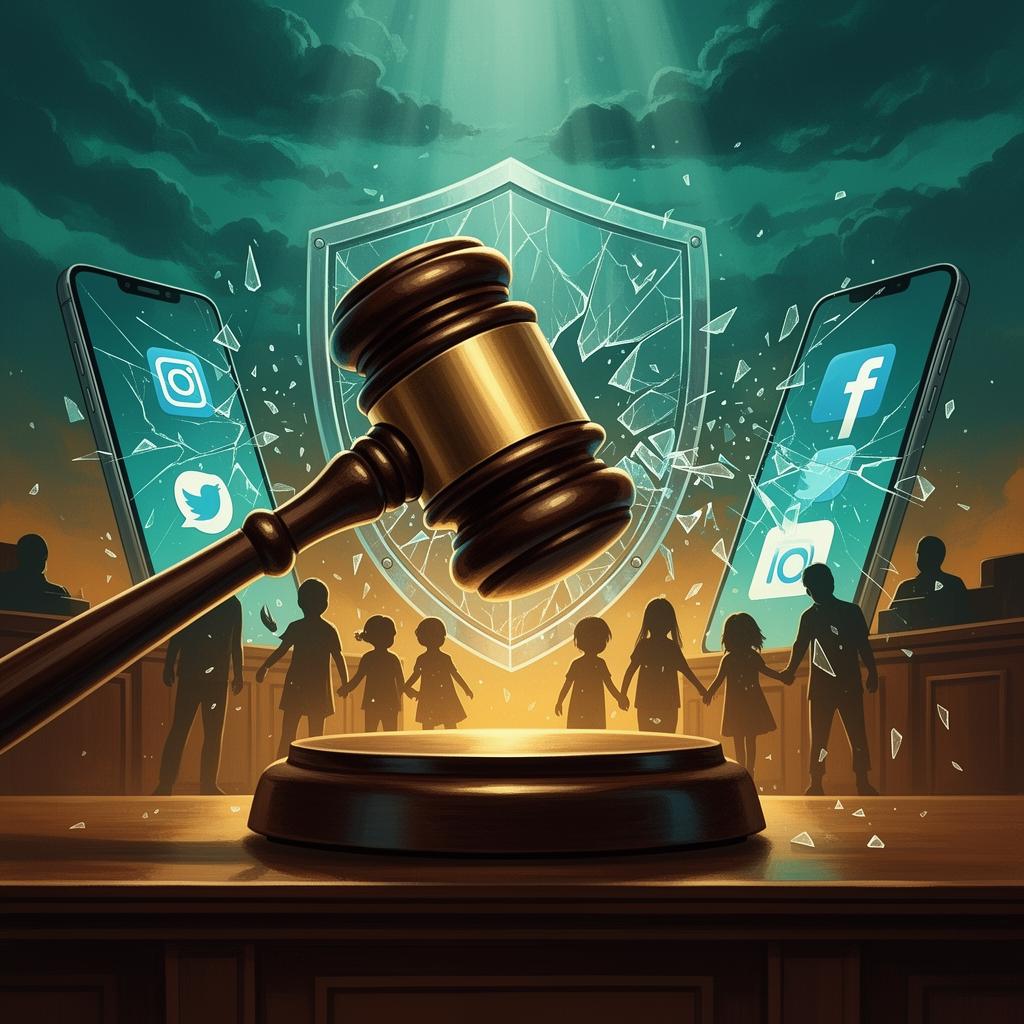
Today, a Los Angeles jury did what parents have been screaming for someone — anyone — to do for over a decade. They looked Meta and YouTube square in the face and said: you did this, and you knew you were doing it.
In what is being called the most consequential tech accountability verdict in a generation, jurors found both Meta (the parent company of Instagram) and Google's YouTube negligent in the design and operation of their platforms — ruling that their products were a substantial factor in causing serious mental health harm to the plaintiff, a 20-year-old California woman identified as K.G.M. The jury awarded $3 million in compensatory damages and an additional $3 million in punitive damages, finding that both companies acted with malice, oppression, or fraud. Meta was held responsible for 70% of the harm; YouTube for the remaining 30%.
This wasn't a close call. Ten of twelve jurors sided with the plaintiff on every single question posed. The jury answered "yes" to every count of negligence and every count of failure to warn. K.G.M. — known as "Kaley" during the trial — testified that she began using these platforms as a young child, and that their deliberately addictive design features, including infinite scrolling, autoplay, and algorithmic content feeds, fueled a spiral into anxiety, depression, body dysmorphia, and suicidal ideation.
Mark Zuckerberg himself took the witness stand. Instagram head Adam Mosseri testified as well. Internal Meta documents were presented showing the company understood how addictive its platforms were for teens — and used that research not to protect young users, but to increase engagement.
Two Verdicts in Two Days
The California ruling came just 24 hours after a New Mexico jury delivered its own devastating blow to Meta. In that case, brought by New Mexico Attorney General Raúl Torrez, a jury found that Meta willfully violated the state's consumer protection laws by misleading users about the safety of Facebook, Instagram, and WhatsApp — and by enabling child sexual exploitation on its platforms. The penalty: $375 million in civil damages, the maximum of $5,000 per violation across tens of thousands of individual violations.
The New Mexico case was built on the back of an undercover investigation in which prosecutors created a fake profile of a 13-year-old girl. That profile was, in the Attorney General's words, "simply inundated" with sexual content and contact from adult predators — leading to criminal arrests. Internal Meta communications revealed that employees had warned leadership that the company's push toward end-to-end encryption would compromise its ability to detect and report child sexual abuse material. Those warnings were apparently disregarded.
Attorney General Torrez called the verdict "a historic victory for every child and family who has paid the price for Meta's choice to put profits over kids' safety."
The Dam Is Breaking
These two verdicts are not isolated events. They are the first waves of a legal tsunami. The California case is a bellwether — a test case tied to more than 2,000 pending lawsuits brought by families, school districts, Native American tribes, and state attorneys general across the country. School districts from Maryland, Georgia, Kentucky, New Jersey, South Carolina, and Arizona have been selected as bellwether cases in the federal multi-district litigation, with trials expected throughout 2026. More than 40 state attorneys general have filed suit against Meta alone. TikTok and Snapchat, originally named alongside Meta and YouTube in the California case, reached settlements before the trial even began — a telling signal that the companies themselves know the evidence against them is damning.
Legal experts are already saying this week's verdicts will set benchmarks for every case that follows. As one analyst put it: "It could open the floodgates of litigation."
So Where Does This Leave Parents?
Here's the uncomfortable truth these verdicts confirm: the platforms your children are using were not built for them. They were built to exploit them.
Not to connect them. Not to educate them. Not to help them grow. To exploit them — to harvest their attention, manipulate their emotions, and convert their developing psychologies into engagement metrics and advertising revenue. The jury in Los Angeles didn't mince words. They found that Meta and YouTube knew their products were dangerous to children and chose not to warn anyone. They found malice. They found fraud.
So what do you do? You can't put the internet back in the box. You can't raise kids in 2026 without some form of digital life. Your children want to communicate, create, share, and belong — and those are healthy, human instincts. The problem was never that kids wanted to be social online. The problem is that the platforms they were given were designed by companies that see them as products, not people.
This is exactly why a platform like Kind Social isn't just a nice idea — it's a necessity.
Social Media Built on Kindness — Not Exploitation
Kind Social represents what social technology should have been all along: a platform built on the premise that connection and safety are not at odds with each other. While Meta was suppressing internal research showing its products harmed teenagers, and while YouTube's recommendation algorithm was funneling children down rabbit holes of increasingly extreme content, Kind Social was being built around a fundamentally different question: What if we designed a social platform that actually served children and families instead of extracting value from them?
For parents, the value proposition is straightforward. Kind Social offers a safe, genuinely social environment — one where your kids can experience the benefits of digital connection without being subjected to the manipulative design patterns that just cost Meta and YouTube $6 million in a single case and $375 million in another. No infinite scroll engineered to hijack dopamine pathways. No algorithmic feeds designed to maximize outrage and insecurity. No strangers in your child's DMs. No predatory data collection funding a surveillance advertising machine.
But Kind Social isn't just about what it doesn't do. It's about what it offers: a platform with apps that give families real, positive value. A place where being social means being actually social — connecting with people who matter, sharing in ways that build kids up rather than tearing them down, and engaging with technology in a way that parents can feel genuinely good about.
The Moment of Reckoning Is Here
The courtrooms in Los Angeles and Santa Fe have now confirmed what millions of parents already knew in their bones: Big Tech built a machine that chews up children and spits out engagement data. The executives knew. The engineers knew. The researchers knew. And they did it anyway, because the money was too good.
The legal consequences are only beginning. Billions of dollars in liability are on the horizon. Regulatory mandates are coming. But parents cannot afford to wait for legislation or litigation to protect their kids. The verdict is in — literally — and it says that the platforms dominating your child's screen time were built with reckless disregard for their wellbeing.
You have a choice. You can keep hoping that the same companies found liable for acting with "malice, oppression, or fraud" will suddenly start prioritizing your child's mental health. Or you can choose something different. Something built from the ground up to be what social media should be.
Kind Social exists because this moment was always coming. Because some people refused to accept that exploiting children was just the cost of doing business in the digital age. Because kindness — real, structural, designed-into-the-architecture kindness — is not naive. It's necessary.
The juries have spoken. The evidence is undeniable. The time for a better alternative isn't tomorrow. It's right now.
To learn more about Kind Social and how it can provide a safer digital experience for your family, visit www.kindsocial.ai.